
DESTINATIONS / SAUDI ARABIA
Where ancient kingdoms sleep beneath desert stars, and a new Arabia rises with open doors
Saudi Arabia is the Arabian Peninsula's heartland, a kingdom where pre-Islamic Nabataean tombs, Ottoman mud-brick palaces, and futuristic megacity projects coexist across 830,000 square miles of desert, mountains, and Red Sea coastline. Since opening to tourism in 2019, the kingdom has emerged as the most exciting new destination in luxury travel.
60-SECOND SNAPSHOT
Saudi Arabia is the Arabian Peninsula's heartland, a kingdom where pre-Islamic Nabataean tombs, Ottoman mud-brick palaces, and futuristic megacity projects coexist across 830,000 square miles of desert, mountains, and Red Sea coastline. Since opening to tourism in 2019, the kingdom has emerged as the most exciting new destination in luxury travel.
01
A vast kingdom spanning the birthplace of Islam, the ancient Nabataean south, the fertile Asir mountains, and the cosmopolitan Hijaz coast. Home to five UNESCO World Heritage sites and the $500 billion NEOM vision.
02
Cultural archaeologists, luxury desert campers, spiritual travelers, architectural enthusiasts, and pioneers who want to experience a destination before the crowds arrive.
03
7-10 days for a focused heritage circuit (AlUla, Riyadh, Jeddah). 12-14 days for comprehensive exploration including the Asir mountains and Red Sea coast.
WHY IT'S SPECIAL
01
Hegra (Madain Saleh) is Petra's southern twin, carved by the same civilization into equally dramatic sandstone outcrops. With 131 tombs and fewer than 50,000 annual visitors, it offers a serenity Petra lost decades ago. The scale, detail, and solitude create an emotional experience unmatched in the Middle East.
02
AlUla is not merely an archaeological site. It is a 200,000-year-old valley where human settlement has been continuous since the Stone Age. Dadanite lion sculptures, Lihyanite inscriptions, and Nabataean facades sit beside palm oases and modern luxury resorts. The valley changes color hourly, from rose at dawn to burnt amber at sunset.
03
Saudi Arabia is investing hundreds of billions in tourism infrastructure. New airports, luxury resorts, museums, and heritage restoration projects are opening monthly. Visiting now means experiencing the birth of a tourism superpower, before prices rise and exclusivity fades.
04
Saudi hospitality (karam) is not a performance for tourists. It is a cultural pillar rooted in Bedouin tradition. Guests are offered dates and qahwa (Arabic coffee) within minutes of any meeting. Invitations to family homes are common and sincere. The warmth surprises first-time visitors.
DEFINING QUALITIES
01
Five UNESCO sites in one country. Hegra, Diriyah, Al-Balad, Rock Art of Hail, and the pilgrimage routes. No other Middle Eastern nation matches this concentration.
02
From the black lava fields of Harrat Rahat to the golden dunes of the Empty Quarter, the white sands of the Nafud, and the red canyons of AlUla. Every desert has a distinct personality.
03
The Sarawat Mountains run 1,600 miles down the west coast, rising to 10,000 feet at Jabal Sawda. Asir's green terraces and juniper forests defy every stereotype about Saudi Arabia.
04
1,100 miles of undeveloped coastline with coral reefs rivaling Egypt's best. The Farasan Islands and the wrecks near Jeddah offer world-class diving without the crowds.
05
Riyadh's glass towers and financial districts sit 12 miles from Diriyah's 300-year-old mud walls. Jeddah's coral-stone old town neighbors super-malls. The contrast is staggering.
06
Unlike Dubai's manufactured tourism, Saudi experiences are rooted in living tradition. The camel market in Riyadh, the date harvest in AlUla, and the oud distilleries in Jeddah are daily life, not staged shows.
TOP HIGHLIGHTS
01
131 Nabataean tombs including Qasr al-Farid, the Lonely Castle, carved from a single rock outcrop. The symmetry and scale rival Petra's Treasury.
02
900 mud-brick houses, narrow alleyways, a 10th-century fort, and a palm oasis fed by ancient qanat irrigation channels.
03
The Library of Arabia. Thousands of inscriptions from Dadanite, Lihyanite, and Nabataean civilizations dating to 1,000 BCE.
04
The birthplace of the Saudi kingdom. Mud-brick palaces, the historic mosque, and Salwa Palace restored to UNESCO standards.
05
650-year-old coral-stone merchant houses with distinctive rawasheen wooden balconies. The Nasseef House and Makkah Gate are architectural masterpieces.
06
eight galleries spanning from prehistoric Arabia to the modern kingdom.
07
A dramatic 1,000-foot cliff 55 miles from Riyadh overlooking an endless plain. The most spectacular vista in the kingdom.
08
The wreck of the SS Cable Layer and the coral gardens of the Farasan Islands offer diving without the crowds of Sharm el-Sheikh.
09
A natural sandstone formation resembling an elephant with a trunk touching the ground. Iconic AlUla photography spot.
10
Modern dining overlooking Diriyah's restored mud-brick district. Where ancient architecture meets contemporary Saudi cuisine.
IDEAL DURATION
01
Covers AlUla (Hegra, Old Town, Jabal Ikmah) plus Riyadh (Diriyah, National Museum, Masmak Fortress). Suitable for travelers combining Saudi Arabia with Jordan in a 12-13 day multi-country tour. You see the archaeological and cultural essentials but miss the coast.
02
Adds Jeddah's Al-Balad, the Red Sea Corniche, and a day trip to the Edge of the World. This is the recommended minimum for a standalone Saudi visit. You experience the full triangle: ancient (AlUla), historical (Diriyah), and cosmopolitan (Jeddah).
03
Includes everything above plus the Asir Mountains (Abha, Soudah Peak at 10,000 feet, Rijal Almaa village) and the Red Sea coast (Al Wajh, Umluj, or the Farasan Islands). For photographers, nature lovers, and travelers who want to challenge every stereotype about Saudi Arabia.
04
For the truly intrepid. Adds the Empty Quarter (Rub' al Khali) with luxury desert camp, the Eastern Province (Al-Ahsa Oasis, world's largest oasis), and potentially the Nabatean sites of Mada'in Saleh beyond Hegra. Requires significant travel time between regions.
BEST TIME + COMFORT
Operating details (hours, permit rules, and access conditions) can change. We confirm the latest details for your exact travel dates.
01
Ideal temperatures (65-85°F), clear skies, and comfortable for all activities. AlUla's winter light is exceptional for photography. Book luxury camps and resorts 120+ days ahead. Prices peak 25-40% above baseline.
02
Extremely hot (95-110°F). AlUla and Riyadh reach 105°F regularly. Activities limited to early morning (6:00-10:00 AM) and evening (5:00-8:00 PM). Indoor attractions (museums, malls) fill afternoon itineraries. Prices drop 30-40%.
03
Jebel Akhdar and AlUla's rose harvest. Distilleries operate daily. Resorts book 150+ days ahead. This is the most beautiful window but also the most crowded.
04
Riyadh and Jeddah are pleasant (68-77°F). Desert nights drop to 45-50°F. Pack layers. Christmas and New Year see increased domestic tourism.
01
00-8:00 AM): The best light for Hegra photography. Cool temperatures. Empty sites. Worth waking early for.
02
00-11:00 AM): Ideal for outdoor hiking, village walks, and archaeological exploration before heat builds.
03
00 AM-3:00 PM): Retreat to museums, resort spas, or air-conditioned restaurants. Outdoor activity is unpleasant in summer and draining even in winter.
04
00-5:00 PM): Resume outdoor exploration as temperatures drop. The light turns golden.
05
30-6:30 PM): Elephant Rock, Hegra tombs, and Diriyah's mud walls glow in amber light. Photography peak.
06
00-10:00 PM): Dinners in Al-Balad, Bujairi Terrace, or AlUla Old Town. The temperature becomes pleasant. Night markets in Jeddah come alive.
GETTING THERE + ROUTING LOGIC
01
New international airport with direct flights from Dubai, Doha, Riyadh, Jeddah, and Cairo. The primary gateway for heritage tourism.
02
King Khalid International Airport. Major hub with connections to every continent. 12 miles from Diriyah, 35 miles from city center.
03
King Abdulaziz International Airport. The Hajj terminal is one of the world's largest. Gateway for Red Sea coast and Al-Balad.
04
Eastern Province hub. Useful for Al-Ahsa Oasis and Bahrain extensions.
01
The primary land crossing for Jordan-Saudi multi-country tours. 110 miles from Aqaba, 2.5-hour drive. Jordan Journey coordinates border formalities and vehicle handover.
02
Fly Aqaba to Riyadh or Jeddah via Dubai/Doha. Jordan Journey books connecting flights and manages baggage transfer.
03
Domestic flights connect all major hubs (Riyadh-Jeddah 1.5 hours, Riyadh-AlUla 2 hours). Road distances are vast: Riyadh to Jeddah is 600 miles (10-hour drive). Internal flights are essential.
The classic heritage triangle is AlUla -> Riyadh -> Jeddah, or reverse. AlUla demands the most energy (outdoor walking, desert heat). Jeddah is the most relaxed (coastal, urban, dining). We typically sequence AlUla first when coming from Jordan, then Riyadh, then Jeddah for departure.
EXAMPLE DAY PLAN A
Every itinerary is adjusted for season, arrival times, access conditions, and traveler pace.
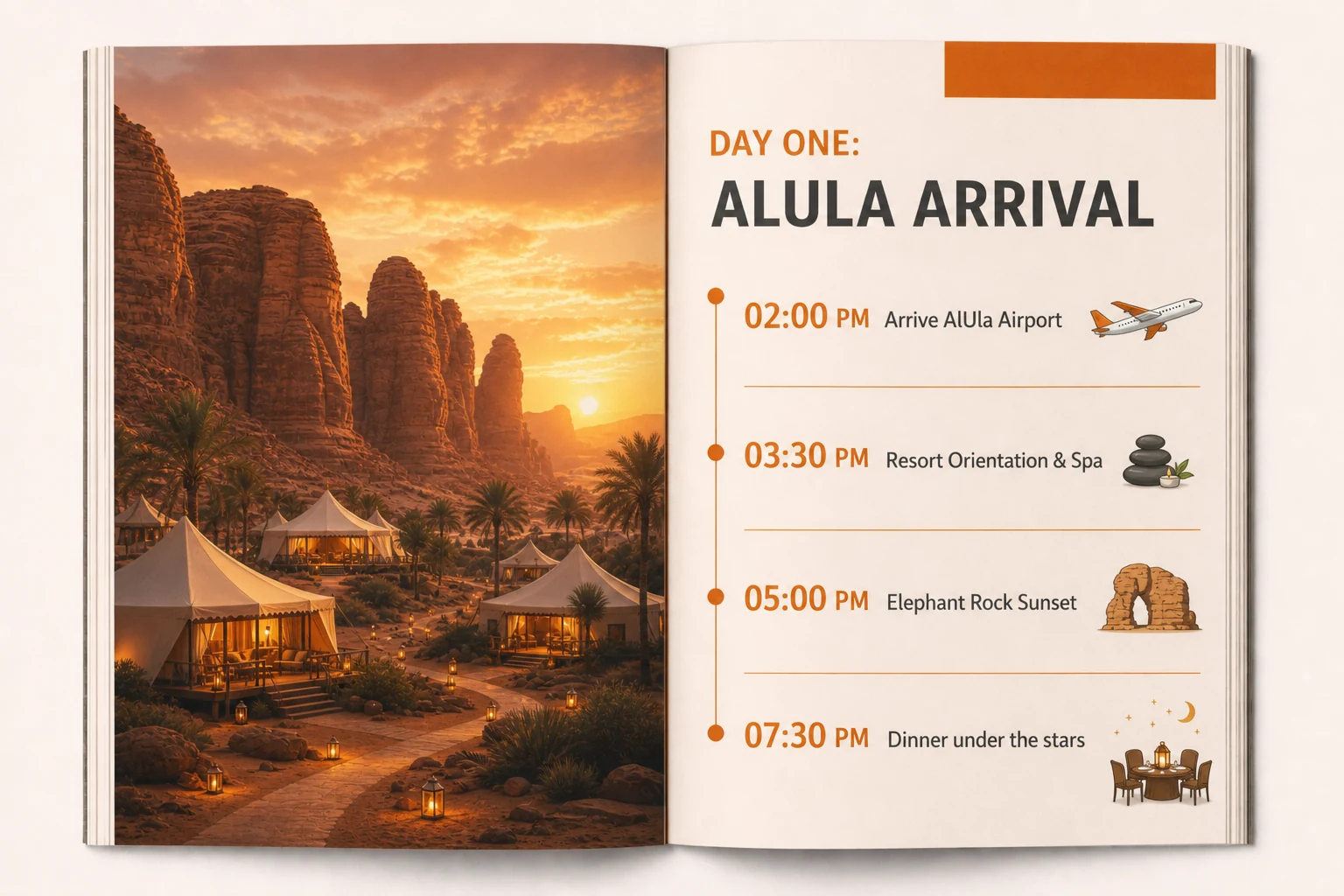
DAY 01
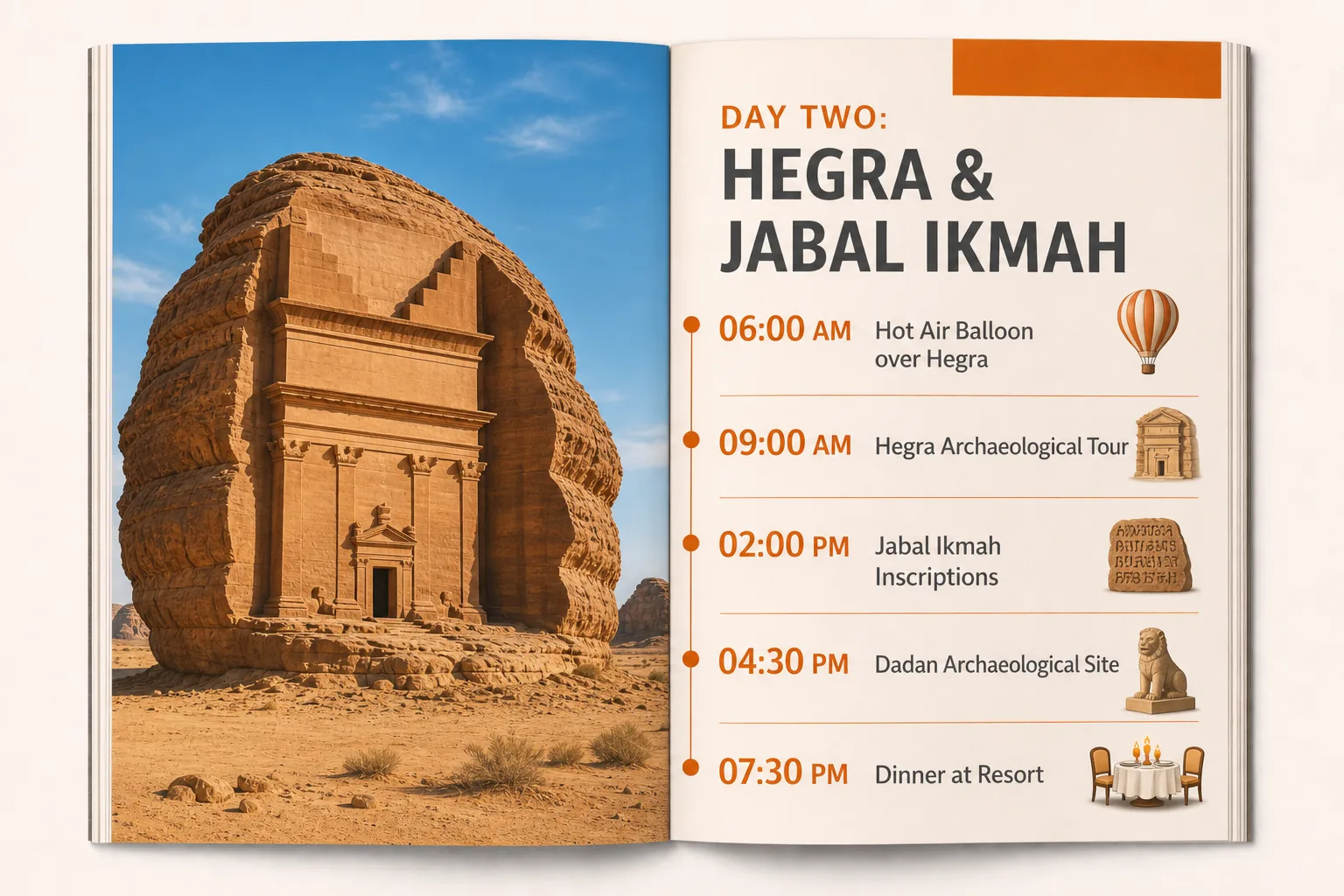
DAY 02
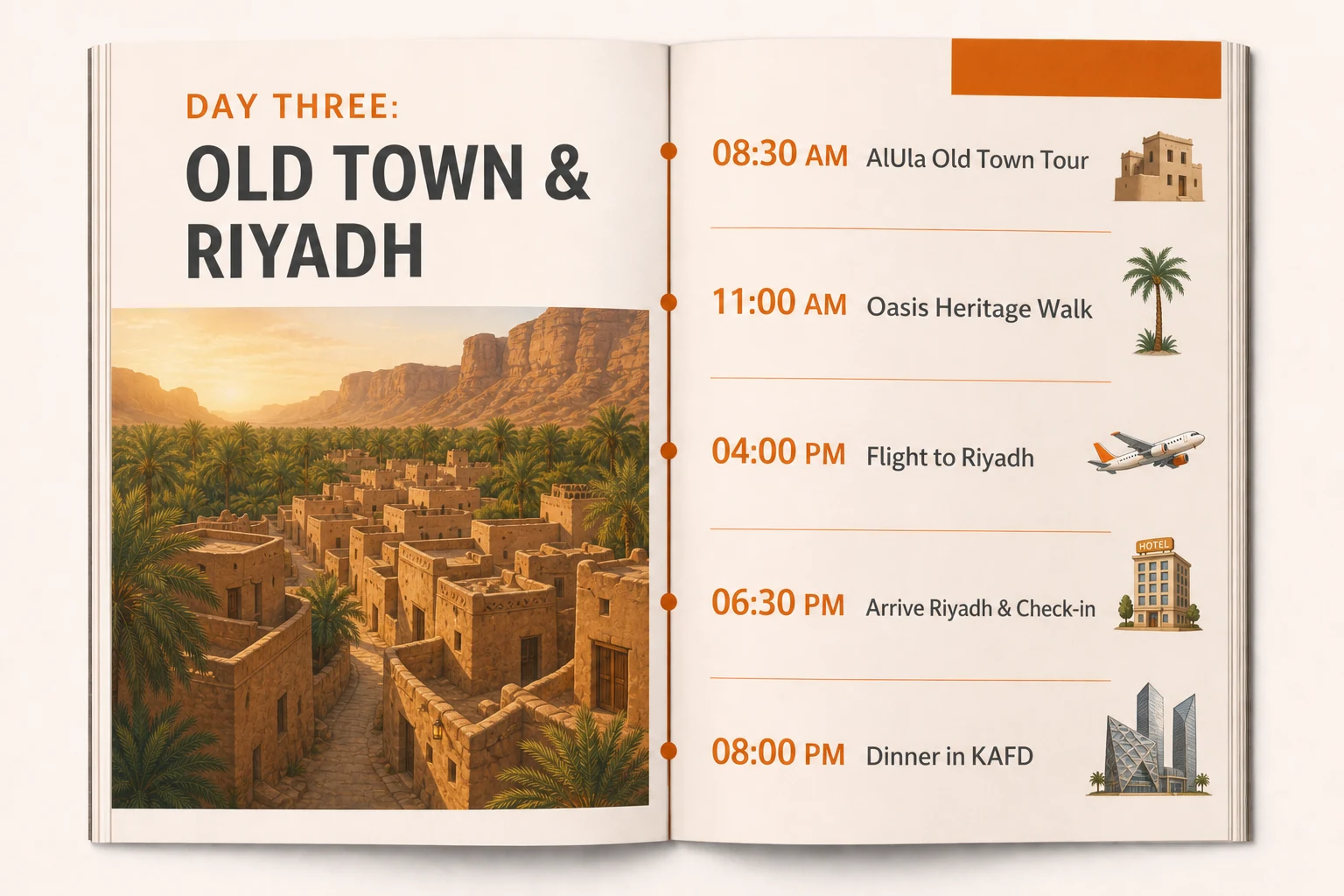
DAY 03
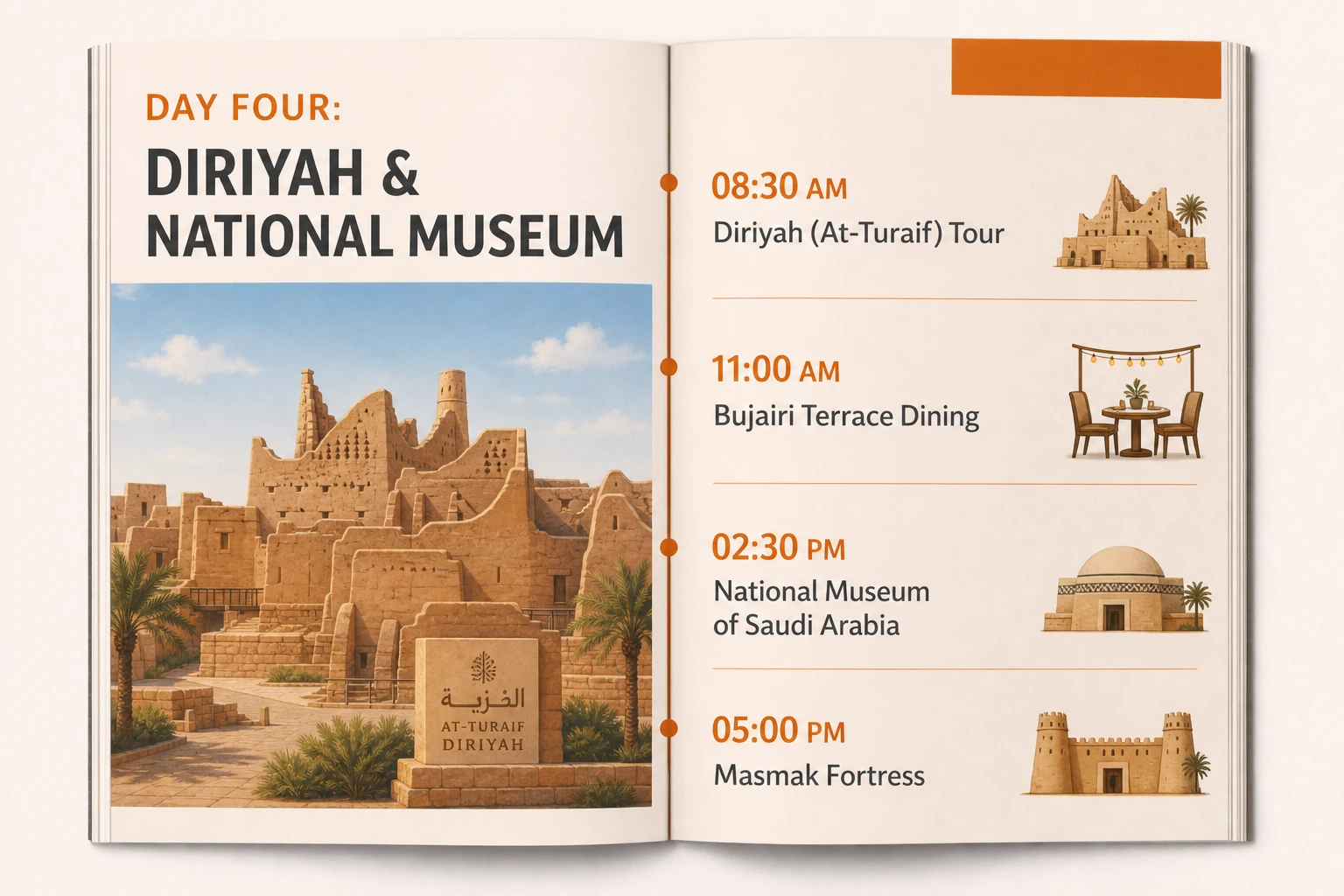
DAY 04
DAY 05
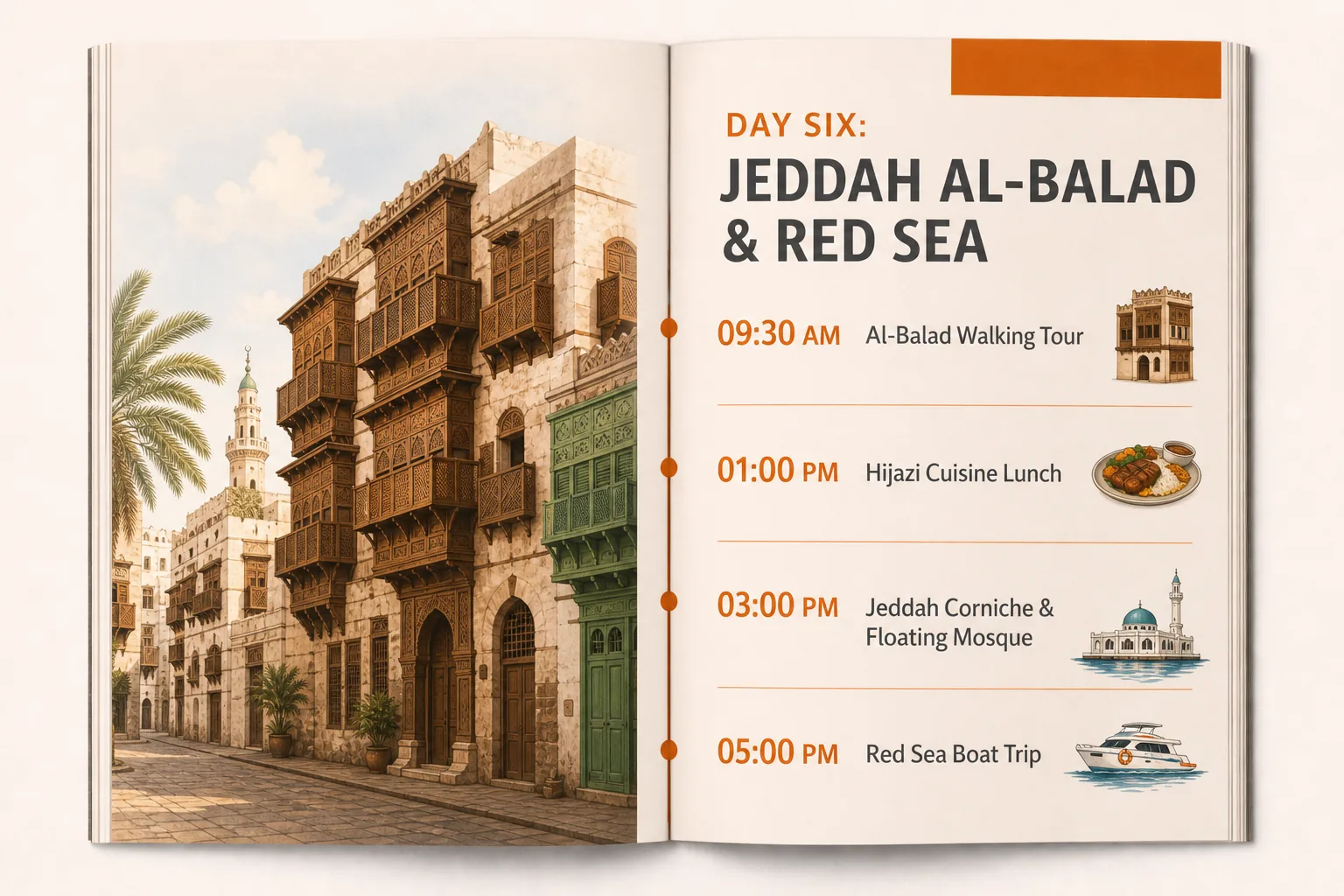
DAY 06
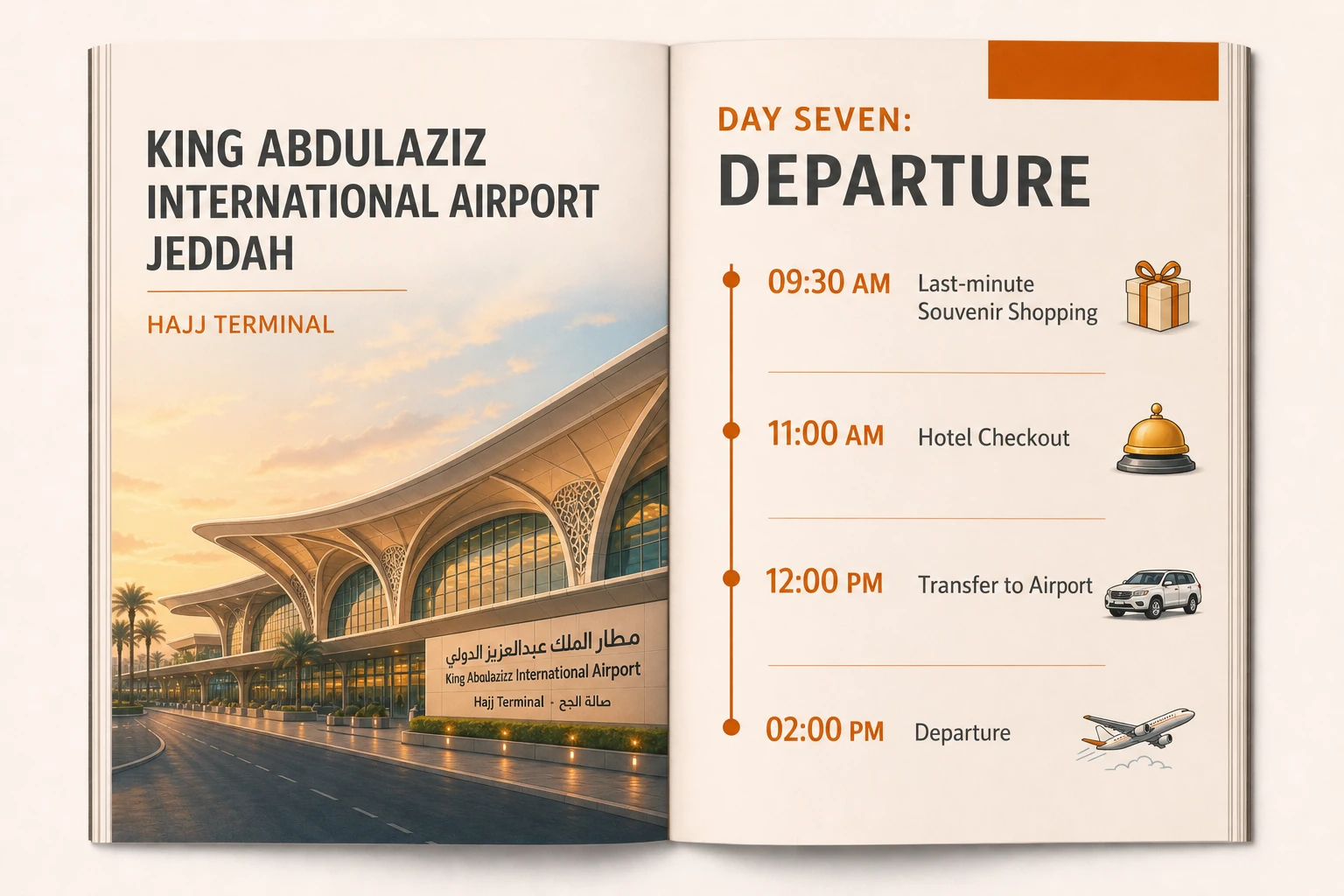
DAY 07
EXAMPLE DAY PLAN B
A shorter framework for a combined Arabia itinerary.
01
14:00 – Arrive AlUla Airport. Transfer to resort.
17:00 – Elephant Rock sunset. Dinner at resort.
02
08:00 – Hegra full-day exploration with guide.
13:00 – Lunch at visitor center.
15:00 – Jabal Ikmah inscriptions.
18:00 – Return to resort. Dinner.
03
08:00 – Old Town and oasis walk.
12:00 – Lunch.
16:00 – Flight to Riyadh.
19:00 – Arrive Riyadh. Hotel check-in. Dinner.
04
08:00 – Diriyah and At-Turaif.
12:00 – Lunch at Bujairi Terrace.
14:30 – National Museum.
17:00 – Masmak Fortress.
19:30 – Farewell dinner.
05
09:00 – Kingdom Center Sky Bridge.
11:00 – Souk shopping.
13:00 – Transfer to airport. Departure.
WHERE TO STAY
01
AlUla's accommodation scene has transformed since 2019. Luxury tented resorts (Habitas AlUla, Banyan Tree AlUla, Ashar Valley villas) offer private pools, canyon views, and world-class dining within minutes of Hegra. For mid-range travelers, cloud-shaped domes and boutique lodges provide comfort without premium pricing. Budget options exist in AlUla Old Town but lack resort amenities.
02
The King Abdullah Financial District (KAFD) hosts international luxury brands: Four Seasons, Ritz-Carlton, Mandarin Oriental. The Diplomatic Quarter offers quieter boutique options near embassies and parks. For heritage immersion, Diriyah's boutique properties (Bujairi Terrace residences) place you inside the UNESCO district.
03
The Corniche (waterfront) has the best sea-view hotels: Park Hyatt, Rosewood, The Chedi. Al-Balad district offers restored heritage hotels in coral-stone merchant houses: authentic atmosphere but smaller rooms and limited elevators. For business travelers, the Tahlia Street area provides modern convenience.
Heritage proximity: In AlUla, choose resorts within 15 minutes of Hegra for sunrise access. In Riyadh, Diriyah properties require 30-minute drives to city center.
Seasonal pricing: October-April sees 40% price increases. May-September offers significant discounts but limited outdoor enjoyment.
Resort packages: Many AlUla resorts include guided Hegra visits, spa credits, and dining packages. Compare inclusions before booking independently.
Cultural sensitivity: All hotels in Saudi Arabia are gender-appropriate. Unmarried couples may face room-sharing restrictions at budget properties. International luxury hotels are generally flexible.
WHAT TO PACK + PRACTICAL TIPS
01
Modest, loose-fitting clothing: long sleeves and pants for men and women. Shoulders and knees must be covered at all times in public.
Abaya: Women no longer legally required to wear one in most places, but pack a lightweight black abaya for mosque visits and conservative areas. Some sites provide them.
Warm layers: Desert nights drop to 45°F even in spring. A fleece or light jacket is essential year-round.
Closed-toe shoes: For Hegra walking, desert terrain, and Riyadh's historic sites. Sandals acceptable only at resorts and beaches.
Sun hat with brim and UV-blocking sunglasses: Essential. The sun is unforgiving.
02
Sunscreen SPF 50+: High altitude and desert air intensify UV exposure.
Rehydration salts and electrolyte tablets: Dehydration is the primary health risk.
Universal power adapter: Type C/G plugs. Voltage 220V.
Power bank: Essential for long days without access to charging.
Camera with dust protection: Desert sand damages equipment. Bring lens cleaning kit and protective bags.
Refillable water bottle: Resorts and guides provide bottled water, but a personal bottle reduces waste.
Personal first-aid kit: Including anti-diarrheal medication and basic pain relievers.
03
Embrace the pace: Saudi culture moves slowly. Meals are long. Conversations are unhurried. Do not schedule tightly.
Learn basic Arabic greetings: Marhaba (hello), shukran (thank you), ma'a salama (goodbye). Effort is deeply appreciated.
Accept coffee and dates: Refusing is culturally awkward. Even if you drink nothing, accept the offer.
Photography etiquette: Ask before photographing people, especially women. Never photograph government buildings, airports, or military installations.
Friday closures: Many shops and restaurants close during Friday prayers (11:00 AM-1:00 PM). Plan accordingly.
No alcohol: Saudi Arabia is dry. Do not bring alcohol into the country. Penalties are severe.
EXTEND YOUR TRIP
01
Add 3-4 days for Abha, Soudah Peak (10,000 feet), and Rijal Almaa village. The green terraces and mountain markets defy every desert stereotype.
02
Add 2-3 days for Al Wajh, Umluj (the 'Maldives of Saudi Arabia'), or the Farasan Islands. World-class diving and snorkeling without crowds.
03
Add 2 days for Al-Ahsa Oasis (world's largest oasis, UNESCO-listed) and the Dammam-Khobar metropolitan area.
04
The natural pairing. Combine Saudi Arabia's Hegra with Jordan's Petra for the complete Nabataean experience. Jordan Journey's Ancient Kingdoms Trail (JJ-MULTI-046) handles the Al Hadithah border crossing.
05
After Saudi Arabia's ancient heritage, experience the UAE's futuristic modernity. The contrast is staggering. Jordan Journey's Deserts to Skyscrapers tour (JJ-MULTI-047) coordinates the flight connection.
FAQ
01
Most nationalities (US, UK, Canada, EU, Australia) can obtain an e-visa online for approximately 130 USD. Processing takes 3-5 business days. Jordan Journey handles the entire application, including invitation letter support. Apply at least 30 days before travel.
02
Yes. Crime rates are extremely low. The Saudi government prioritizes tourist safety. All tourist areas (AlUla, Riyadh, Jeddah) are heavily monitored and well-patrolled. Follow local laws strictly: no alcohol, no drugs, no public displays of affection. Respect religious customs.
03
Yes. Women can now drive, travel independently, and stay in hotels alone. However, solo female travelers should exercise standard precautions: avoid walking alone at night in unfamiliar areas, dress modestly, and inform hotel staff of your itinerary. Jordan Journey provides female guides on request for women travelers.
04
Saudi cuisine is delicious and varied. Highlights include kabsa (spiced rice with chicken or lamb), mutabbaq (stuffed pastry), jareesh (crushed wheat porridge), and fresh dates. Jeddah's seafood is exceptional. Vegetarian options are available but limited in traditional restaurants. International cuisine is widely available in luxury hotels.
05
Excellent 4G/5G coverage in all cities and most tourist sites. AlUla's remote desert areas have weaker signal. WiFi available at all hotels and resorts. Local SIM cards (STC, Mobily, Zain) cost 15-25 USD with 10-20 GB data. Your guide assists with purchase.
06
Modestly and loosely. Men: long pants and covered shoulders. Women: long skirts or pants, covered shoulders, loose fit. Abaya not legally required in most places but appreciated in conservative areas and mosques. Avoid tight or transparent clothing. Beachwear only at private resort beaches.
07
Yes, universally in hotels, restaurants, and shops. Visa and Mastercard accepted everywhere. American Express less common. Cash useful for souks and small vendors. ATMs widely available. Currency is Saudi Riyal (SAR); 1 SAR = 0.27 USD approximately.
08
Saudi Riyal (SAR) is the official currency. USD is accepted at some tourist sites but change is given in Riyals. We recommend carrying 300-400 USD equivalent in Riyals for tips, souvenirs, and small purchases. ATMs are widely available in Riyadh and Jeddah. Credit cards accepted at all hotels, resorts, and major restaurants. Your guide assists with currency exchange.
09
In tourist areas, hotels, and restaurants: yes. In traditional souks and rural areas: limited. All Jordan Journey guides speak fluent English. Translation apps work well for Arabic. Signs in major tourist sites are bilingual.
10
Yes, but with adjustments. Restaurants closed during daylight hours in most areas, but hotels and resorts serve food normally. Sites may have reduced hours. Evening iftar meals are culturally rich experiences. Non-Muslims are expected to refrain from eating and drinking in public during daylight. Our guides adjust itineraries accordingly.
11
Dates (Ajwa, Sukkari, or Medjool varieties), oud perfume from Jeddah's Al-Balad, traditional silver jewelry, camel leather goods, and rose water from AlUla's distilleries (March-April harvest). Avoid fake antiquities: genuine archaeological artifacts cannot be exported.
12
Heat exhaustion and dehydration are the primary risks. Drink 3-4 liters of water daily. No mandatory vaccinations. Tap water is treated but bottled water recommended. Medical facilities in Riyadh and Jeddah are excellent. Travel insurance with medical evacuation coverage is mandatory.
YOUR JOURNEY, SHAPED AROUND YOU
Our team will shape the sequence, pacing, stays, access, and transfers around your dates and interests.