
DESTINATIONS / JORDAN
The rose-red city, where ancient wonder rewards those who take their time
60-SECOND SNAPSHOT
Petra is a UNESCO World Heritage site and one of the New Seven Wonders of the World—a vast Nabataean city carved into rose-colored sandstone cliffs over 2,000 years ago.
BEST FOR
IDEAL STAY
ROUTING ROLE
An archaeological masterpiece spanning 264 square kilometers, featuring facades, tombs, temples, and a sophisticated water management system that allowed a flourishing city in the desert.
Best for: History enthusiasts, photographers, hikers, and travelers seeking profound cultural immersion. Petra rewards visitors of all fitness levels, though some trails require moderate effort.
Ideal duration: Two full days for most visitors; one day for those short on time; three days for photographers and history deep-divers.
WHY IT IS SPECIAL
Unlike many archaeological sites, Petra reveals itself gradually. The approach through the Siq builds anticipation, and each monument unfolds in sequence. Rushing through misses the atmospheric magic.
01
The 1.2-kilometer canyon entrance creates one of travel's great reveals— emerging from shadow to face the Treasury.
02
Most visitors underestimate Petra's size. The main trail extends 8 kilometers with hundreds of carved facades.
03
The Bedouin community maintains connections to this landscape, adding human dimension to stone.
04
From the Hellenistic Treasury to the Roman-style theatre and the monumental Monastery, Petra spans multiple influences.
05
Options range from flat valley walks to the 800-step climb to the Monastery and the challenging back route.
06
The rose-red stone shifts through color palettes from dawn to sunset, rewarding repeat visits at different hours.
TOP HIGHLIGHTS
Use these highlights to understand the destination’s scale, rhythm, and most rewarding moments.
01
The iconic facade, 40 meters high, carved directly from the cliff face. Best experienced early morning or late afternoon.
02
The narrow gorge entrance with water channels carved into the walls, ancient paving stones, and lingering sense of procession.
03
Petra's largest monument, reached by 800 steps. The plateau offers panoramic views and relative quiet.
04
A cluster of monumental facades including the Urn Tomb, Silk Tomb, and Palace Tomb along the main trail.
05
Seating 6,000 spectators, carved directly from the rock rather than built.
06
The remains of Petra's commercial heart, with temples and public buildings.
07
A challenging climb rewarded with altar remains and sweeping views over the valley.
08
A separate site 8 kilometers north, offering intimate scale and fewer visitors.
IDEAL DURATION
The right length of stay depends on whether this is a highlight, a recovery stop, or a deeper destination in its own right.
01
Suitable for travelers with tight schedules. Covers the Siq, Treasury, Royal Tombs, Theatre, and Colonnaded Street. Requires 6-8 hours of walking. You will see the highlights but miss the Monastery and deeper trails.
02
The sweet spot for most visitors. Day one covers the main trail; day two adds the Monastery climb and either the High Place of Sacrifice or Little Petra. Allows for different lighting conditions and recovery time.
03
For photographers, history enthusiasts, and those seeking quiet moments. Adds the back route to the Monastery, extended exploration of lesser trails, and time to absorb the atmosphere without rushing.
BEST TIME + COMFORT
Season and time of day materially change comfort, visibility, and the quality of the experience.
01
Ideal temperatures, wildflowers in the surrounding hills. Most comfortable for walking. Expect crowds during Easter.
02
Very hot, often exceeding 35 degrees Celsius. Early morning entry (6:00 AM) essential. Afternoon siesta recommended.
03
Excellent conditions, fewer crowds than spring. Pleasant temperatures for climbing.
04
Cool, occasionally rainy. Fewest visitors. Can be cold in shade; layers essential.
TIME OF DAY
00-9:00 AM): Coolest temperatures, soft light on the Treasury, fewest crowds. The Siq is at its most atmospheric.
TIME OF DAY
00-6:00 PM): Warm light on the Royal Tombs, quieter trails. The Monastery receives beautiful evening illumination.
TIME OF DAY
Harsh light and peak heat. Use this time for the museum, rest at your hotel, or explore shaded areas like the Siq. Operating details (hours, ticket rules, and access conditions) can change. We confirm the latest details for your exact travel dates.
Operating details (hours, ticket rules, and access conditions) can change. We confirm the latest details for your exact travel dates
GETTING THERE + ROUTING LOGIC
Petra's main entrance is in Wadi Musa, a town developed around the archaeological site. The visitor center provides maps, facilities, and the ticket office.
01
Most travelers reach Petra from the capital, either as a long day trip (not recommended) or as part of a southern circuit.
02
A natural pairing. Many itineraries sequence Petra after Wadi Rum, allowing the desert experience to precede the archaeological depth.
03
Accessible for those combining Red Sea time with Petra. Useful for travelers entering Jordan through the southern port.
04
Often sequenced as a recovery stop after Petra's physical demands.
01
Approach through Jordan’s central landscapes.
02
Use the scenic route when time allows.
03
Walk the main trail without rushing.
04
Reach the Monastery and deeper sites.
05
Shift from archaeology to desert stillness.
Petra works best as a multi-night anchor in your Jordan itinerary. Position it with buffer days—avoid scheduling long drives on the same day as your Petra visit. The site demands physical energy; protect your pacing.
EXAMPLE DAY PLAN A
Timings are examples and are adjusted for season, access conditions, weather, and your preferred pace.
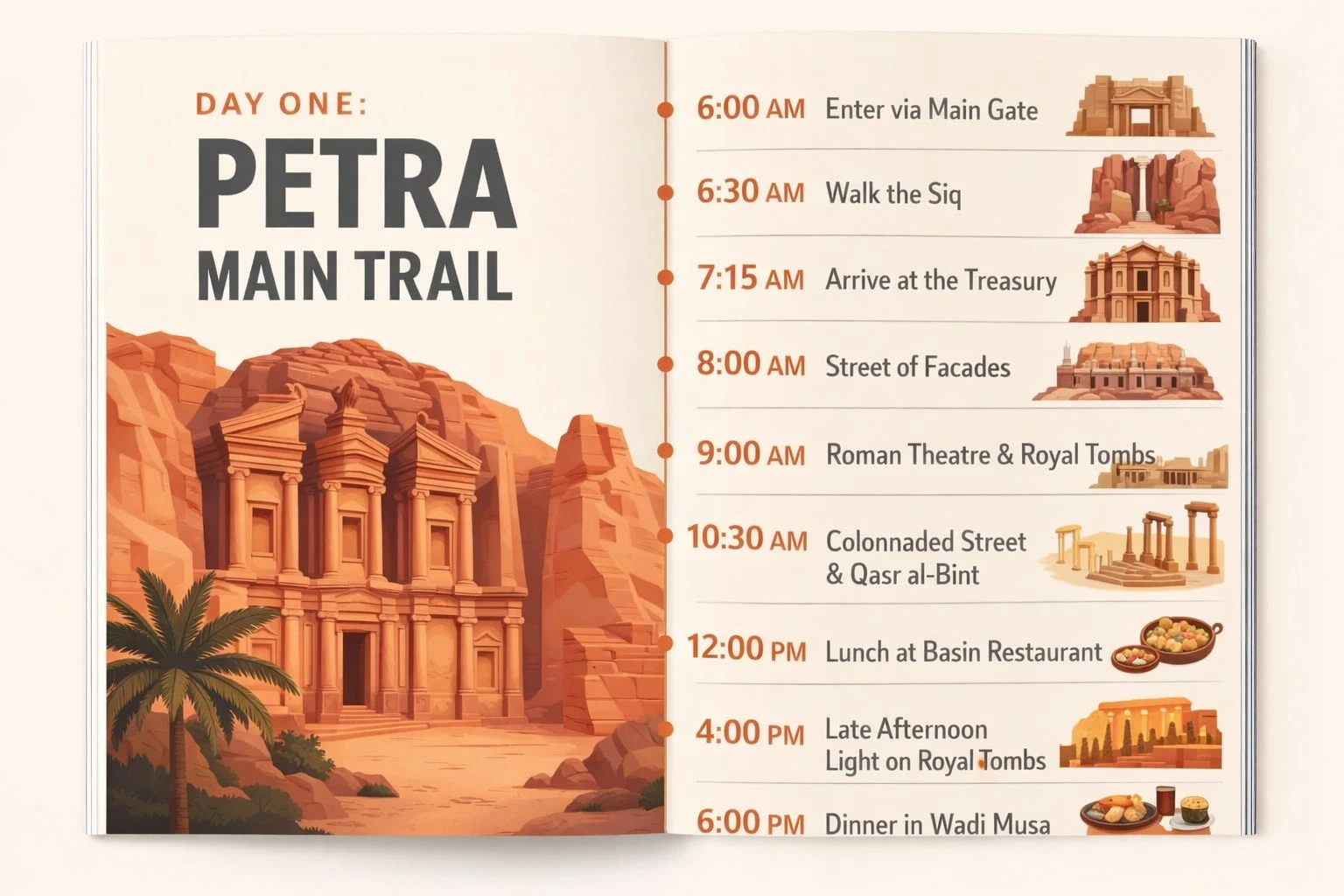
06:00
Enter via main gate. Walk or take the shuttle to the Siq entrance.
06:30
Walk the Siq in morning quiet. Photography stops without crowds.
07:15
Arrive at Treasury. Absorb the reveal. Photography in soft light.
08:00
Continue past the Treasury, exploring the Street of Facades.
09:00
Roman Theatre and Royal Tombs. Rest in shaded areas.
10:30
Colonnaded Street and Qasr al-Bint. Museum visit if desired.
12:00
Lunch at Basin Restaurant (site restaurant) or return to hotel.
14:00
Rest period at hotel. Avoid midday heat.
16:00
Re-enter for late afternoon light on the Royal Tombs.
18:00
Exit before sunset. Dinner in Wadi Musa.
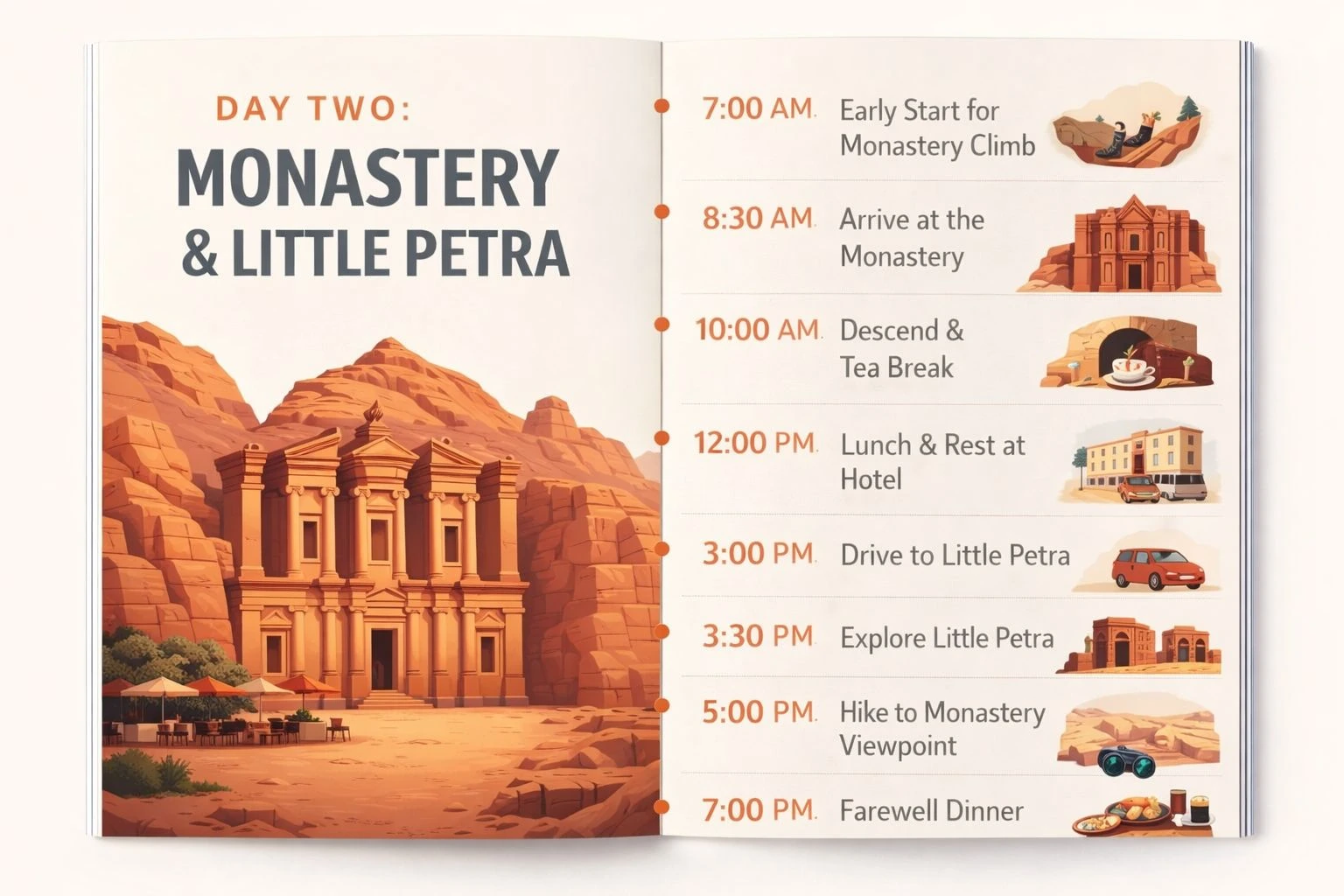
07:00
Early start for the Monastery climb. 800 steps; pace yourself.
08:30
Arrive at Monastery. Explore the plateau and viewpoints.
10:00
Descend at leisure. Tea break at the cave cafes en route.
12:00
Lunch and rest at hotel.
15:00
Drive to Little Petra (8 km). Explore the painted house and siqs.
17:00
Optional: Short hike from Little Petra to the Monastery viewpoint.
EXAMPLE DAY PLAN B
Timings are examples and are adjusted for season, access conditions, weather, and your preferred pace.
07:30
Enter site. Take the horse-drawn carriage to the Siq entrance (included with ticket).
08:00
Walk the Siq at comfortable pace. Multiple benches for rest.
09:00
Treasury viewing and photography. Rest on the opposite benches.
10:00
Flat trail to the Street of Facades and Roman Theatre.
11:30
Royal Tombs from below (no climbing required). Picnic or restaurant lunch.
13:00
Return to hotel for rest and lunch.
16:00
Optional evening return for Petra by Night (Monday, Wednesday, Thursday).
WHERE TO STAY
Location, access, and atmosphere matter more than choosing by hotel name alone.
01
Closest to the entrance gate. Walking distance to the visitor center. Range of options from budget to midrange. Restaurants and shops within easy reach. Best for those prioritizing convenience.
02
Elevated position with views over the valley. Quieter than the town center. Some properties offer character and atmosphere. Requires taxi or hotel shuttle to the entrance.
03
Authentic community setting on the plateau above Petra. Some properties offer traditional experiences and home-cooked meals. Further from the entrance; transport essential.
Prioritize proximity for two-day visits—being able to return to your hotel midday is valuable. For singleday visits, character properties further out work well if they provide transport.
WHAT TO PACK + PRACTICAL TIPS
A few destination-specific choices make the day easier, safer, and more enjoyable.
01
02
03
04
EXTEND YOUR TRIP
Use the destination as part of a connected route rather than an isolated stop.
The natural pairing. Many travelers sequence Petra and Wadi Rum together. The desert's silence complements Petra's stone grandeur. Consider Wadi Rum after Petra to shift from active exploration to contemplative landscape.
If not included in your main Petra days, this satellite site offers intimate scale and fewer visitors. The painted house contains rare surviving Nabataean frescoes.
For nature contrast after Petra's archaeology. Hiking trails through varied ecosystems, traditional villages, and a slower pace.
Position after Petra for recovery. The buoyant waters and spa treatments address tired muscles from climbing.
A Crusader fortress on the road between Petra and Wadi Rum. Less visited than Karak, with atmospheric ruins and panoramic views.
FAQ
These answers provide planning guidance. Exact access conditions and operating details are confirmed for your travel dates.
01
Two days is the recommended minimum for most visitors. This allows you to see the main trail, the Monastery, and experience different lighting conditions. One day covers the essentials; three days enables deeper exploration.
02
Yes, but it requires prioritization. Focus on the Siq, Treasury, Royal Tombs, and Theatre. You will miss the Monastery and deeper trails. Start at 6:00 AM and plan for 6-8 hours of walking.
03
Early morning (6:00-9:00 AM) offers cool temperatures, soft light on the Treasury, and fewer crowds. Late afternoon (3:00-6:00 PM) provides warm light on the Royal Tombs and a quieter atmosphere.
04
Wadi Musa town center offers the most convenience—walking distance to the entrance and restaurants. Properties on Taybeh Road provide views and character but require transport. Umm Sayhoun offers authentic Bedouin community experiences.
05
Both sequences work. Petra first allows you to tackle the physical demands while fresh. Wadi Rum first provides desert tranquility before archaeological intensity. Many itineraries place Petra after Wadi Rum for a natural progression.
06
Yes, with realistic expectations. Young children may find the walking challenging. The horse-drawn carriage helps with the initial distance. Bring snacks, water, and plan for frequent breaks. The Treasury's scale captivates most ages.
07
800 stone steps with some uneven surfaces. Moderate fitness required. Most visitors complete it in 45-60 minutes with rest stops. The descent is easier. Donkeys are available but assess animal welfare conditions before accepting.
08
Comfortable walking shoes with grip are essential. Dress modestly (shoulders and knees covered) out of cultural respect. Layers work best for temperature variation between sun and shade. A hat and sunscreen are non-negotiable.
09
Independent exploration is straightforward with the main trail well-marked. A guide adds historical context and can lead you to less-visited spots. Official guides are available at the visitor center.
10
A Monday, Wednesday, and Thursday evening program where the Siq and Treasury are illuminated by candles. The experience includes Bedouin music and storytelling. Tickets are separate from day entry. Opinions vary—some find it magical, others crowded.
11
The Basin Restaurant near the museum offers buffet meals. Several cave cafes along the Monastery trail serve tea and light snacks. Most visitors prefer to exit for lunch or bring packed meals.
12
A satellite Nabataean site 8 kilometers north of the main entrance. Smaller scale, fewer visitors, and the rare painted house with surviving frescoes. Easily combined with a main Petra day or visited separately.
13
Minimum two liters per person for a full day. Summer demands more. Refill stations exist but are limited. Dehydration is the most common visitor discomfort—plan accordingly.
14
Facilities exist at the visitor center, near the Theatre, and at the Basin Restaurant. Plan accordingly as options are limited along the trails.
JORDAN JOURNEY
A Jordan Journey specialist can connect Petra with the right accommodation, transportation, experiences, and onward route around your dates and priorities.