
DESTINATIONS / OMAN
Where mountain terraces touch the sky, desert dunes sing in the wind, and turquoise pools hide in secret canyons
Oman is the Arabian Peninsula's best-kept secret, a sultanate where ancient forts, mountain villages, desert camps, and fjord-like coastlines coexist within a few hours' drive. While Dubai built towers, Oman protected its heritage: no building in Muscat exceeds eight stories.
60-SECOND SNAPSHOT
Oman is the Arabian Peninsula's best-kept secret, a sultanate where ancient forts, mountain villages, desert camps, and fjord-like coastlines coexist within a few hours' drive. While Dubai built towers, Oman protected its heritage: no building in Muscat exceeds eight stories.
01
A country of staggering natural diversity in a compact area. Muscat's whitewashed architecture, Jebel Akhdar's terraced rose gardens at 6,500 feet, Wahiba Sands' 300-foot dunes, Wadi Shab's turquoise pools, and Sur's dhow shipyards create a complete Arabian experience.
02
Nature lovers, cultural travelers, hikers, photographers, families, and anyone seeking authentic Arabia without the crowds or artificiality of Dubai.
03
7-8 days for the essential circuit (Muscat, Nizwa, Jebel Akhdar, Wahiba Sands). 10-12 days for comprehensive exploration including Wadi Shab, Sur, and the Musandam Peninsula.
WHY IT'S SPECIAL
01
Jebel Akhdar, the Green Mountain, defies every desert stereotype. At 6,500 feet, villages cling to cliffsides where terraces of roses, pomegranates, and walnuts flourish. Ancient falaj irrigation channels bring water from springs. The air smells of rose petals in spring and damp stone after rain. This is not the Arabia of headlines.
02
A 45-minute hike through palm groves and rocky canyon leads to a series of turquoise pools. Swim through the final pool, duck beneath a rock overhang, and emerge in a cave where a waterfall cascades from above. The water is cool, the light is ethereal, and the experience feels discovered rather than designed. No ticket booth. No queue. Just nature.
03
Unlike Wadi Rum's uniform rust, Wahiba's dunes shift from honey to amber to deep red depending on mineral content and sun angle. The ridges reach 300 feet, creating shadows that move like living things. At sunrise, the sand sings. Local Bedouin call it the 'singing sands' phenomenon. Luxury camps here are smaller and more intimate than Jordan's.
04
Sur's shipyard has built wooden dhows using the same techniques for 500 years. No nails. Just hand-carved teak, coconut fiber caulking, and fish oil. Watching a master craftsman shape a hull with an adze is watching living history. The nearby lighthouse and watchtowers guard a lagoon that has launched trade vessels to India and East Africa for centuries.
DEFINING QUALITIES
01
Mountains, deserts, coastlines, canyons, and oases within a 4-hour drive. No other Arabian country offers this density of landscapes.
02
The Sultan Qaboos Grand Mosque, Nizwa's Friday goat market, and Jebel Akhdar's rose distilleries are living culture, not staged for tourists.
03
Muscat's building codes require Arabesque designs and limit height to 8-10 stories. The result is a beautiful, human-scaled city unlike Dubai's vertical frenzy.
04
Omani hospitality is legendary. You will be invited to share dates and qahwa within minutes of meeting locals. Guesthouses in mountain villages operate on trust.
05
The Gulf of Oman and Arabian Sea host coral reefs, dolphin pods, whale sharks (seasonal), and sea turtles. The Daymaniyat Islands are a protected marine reserve with world-class snorkeling.
06
Oman has 4.5 million people across 120,000 square miles. The emptiness is the luxury. Drive for an hour without seeing another vehicle. Camp on a beach with no footprints but yours.
TOP HIGHLIGHTS
01
600,000-crystal chandelier, 21-ton hand-woven Persian carpet, 164-foot main dome. The most beautiful mosque in the Arabian Peninsula.
02
A 17th-century circular fort with trap doors, hidden passages, and a summit view over the date palm oasis. The Friday goat market is the Gulf's most authentic souk.
03
Terraced villages, rose gardens, pomegranate orchards, and ancient falaj irrigation at 6,500 feet. Alila Jebel Akhdar offers cliff-edge luxury.
04
Hike through palm groves to turquoise pools, then swim to a hidden waterfall cave. The most beautiful wadi in Oman.
05
300-foot dunes that change color from honey to red. Luxury desert camps with private tents, ensuite bathrooms, and Bedouin hosts.
06
Watch master craftsmen build traditional wooden sailing vessels using 500-year-old techniques. No nails. Just teak, fiber, and oil.
07
Green turtles nest on the beach from May to October. Pre-dawn guided tours watch 300-pound females haul ashore to lay eggs.
08
Incense alley, frankincense and myrrh vendors, silver khanjar daggers, and traditional textiles. The sensory experience of old Arabia.
09
A turquoise limestone pool 200 feet from the sea, connected by underground tunnels. Swimming in crystal-clear water surrounded by rock walls.
10
Protected marine reserve with coral reefs, sea turtles, and dolphin pods. Snorkeling and diving day trips from Muscat.
IDEAL DURATION
01
Covers Muscat (mosque, souk, old town), Nizwa (fort, market), Jebel Akhdar (village walks, rose terraces), and Wahiba Sands (desert camp). Suitable for travelers combining Oman with Jordan in a 12-13 day multi-country tour (JJ-MULTI-048). You miss the coast but experience the core.
02
Adds Wadi Shab (swimming, waterfall cave), Sur (dhow shipyard, lighthouse), and the coastal drive. This is the sweet spot: mountains, desert, and coast in one week. You understand why Oman is called Arabia's best-kept secret.
03
Includes everything above plus the Musandam Peninsula (fjord-like coastline, dhow cruises, Khasab), Salalah (monsoon season, green mountains, frankincense groves), and the Empty Quarter border. For travelers who want to see every facet of Oman.
04
Only recommended as part of a multi-country tour. Covers the Grand Mosque, Muttrah Souk, old Muscat, and a day trip to Wadi Shab or Jebel Akhdar. A taste, not a meal.
BEST TIME + COMFORT
Operating details (hours, permit rules, and access conditions) can change. We confirm the latest details for your exact travel dates.
01
Ideal weather (68-86°F). Clear skies, calm seas, and comfortable mountain hiking. Peak season: book 120+ days ahead for Jebel Akhdar resorts. Prices increase 25-35%.
02
Hot (90-105°F) on the coast and in Muscat. Jebel Akhdar remains cooler (75-85°F) due to altitude. Wahiba Sands is extremely hot. Sea breezes make coastal areas bearable. Prices drop 30-40%.
03
Jebel Akhdar's rose harvest. Distilleries operate, rose water flows, and the air is perfumed. Resorts book 150+ days ahead. The most beautiful but most crowded window.
04
The monsoon transforms the southern Dhofar region into a green paradise. Misty mountains, flowing waterfalls, and 70°F temperatures. Unique to Arabia. Salalah-specific season.
01
00-7:00 AM): Best for Wadi Shab (fewer crowds, cooler temperatures, better light). Also ideal for Wahiba Sands photography and Ras Al Jinz turtle tours.
02
00-11:00 AM): Ideal for Nizwa Fort, Muscat mosque visits, and Jebel Akhdar village walks before heat builds.
03
00 AM-3:00 PM): Retreat to resort pools, spa treatments, or museum visits. Outdoor activity is draining even in cooler months.
04
00-5:30 PM): Resume exploration. Souks become active. Light turns golden on Muscat's white buildings.
05
30-6:30 PM): Wahiba Sands dunes glow amber. Jebel Akhdar terraces turn golden. Muscat's Corniche offers sea-and-mountain views.
06
00-10:00 PM): Dinner at Muttrah Corniche restaurants, stargazing at desert camps, or campfire storytelling with Bedouin hosts.
GETTING THERE + ROUTING LOGIC
01
Muscat International Airport. Direct flights from London, Frankfurt, Paris, Dubai, Doha, Mumbai, and Bangkok. The primary gateway for all Oman tourism.
02
Domestic and limited international flights. Gateway for Khareef season and frankincense country.
03
Small airport for Musandam Peninsula. Flights from Muscat only.
01
Fly Aqaba to Muscat (4 hours, typically via Dubai or Doha). Jordan Journey books connecting flights and manages transfers. Most efficient routing.
02
Not practical. No direct land border. Would require crossing Saudi Arabia (1,000+ miles). Not recommended.
03
Road distances are manageable. Muscat to Nizwa is 100 miles (2 hours). Nizwa to Jebel Akhdar is 25 miles (1 hour, 4×4 required). Jebel Akhdar to Wahiba Sands is 120 miles (3 hours). Wahiba Sands to Sur is 80 miles (2 hours). Sur to Muscat is 150 miles (3 hours).
The classic loop is Muscat -> Nizwa -> Jebel Akhdar -> Wahiba Sands -> Wadi Shab/Sur -> Muscat. This is a clockwise circuit that minimizes backtracking. For multi-country Jordan+Oman tours, we typically fly Aqaba-Muscat, run the loop, and depart from Muscat. The loop can be reversed based on flight schedules.
EXAMPLE DAY PLAN A
Every itinerary is adjusted for season, arrival times, access conditions, and traveler pace.
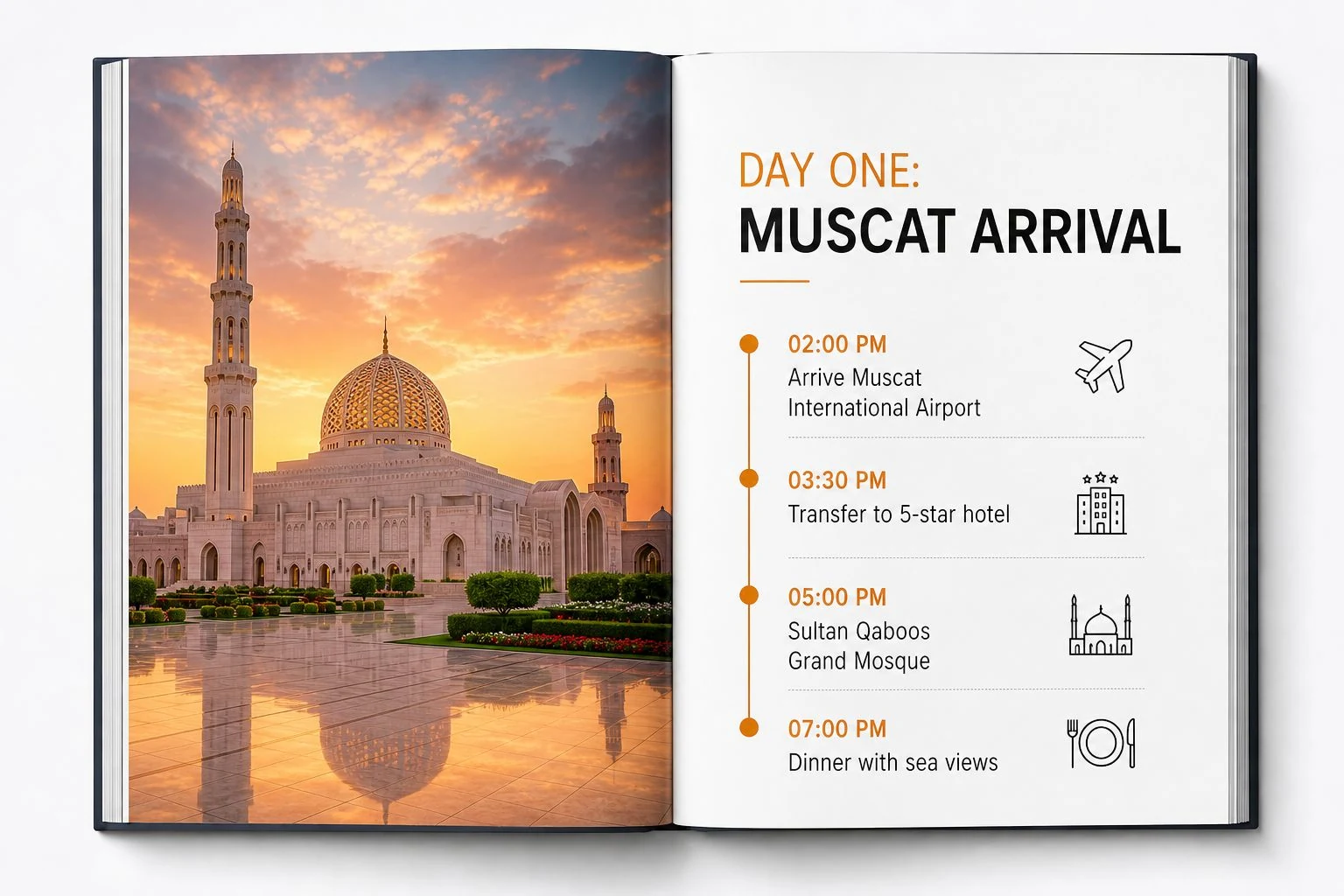
DAY 01
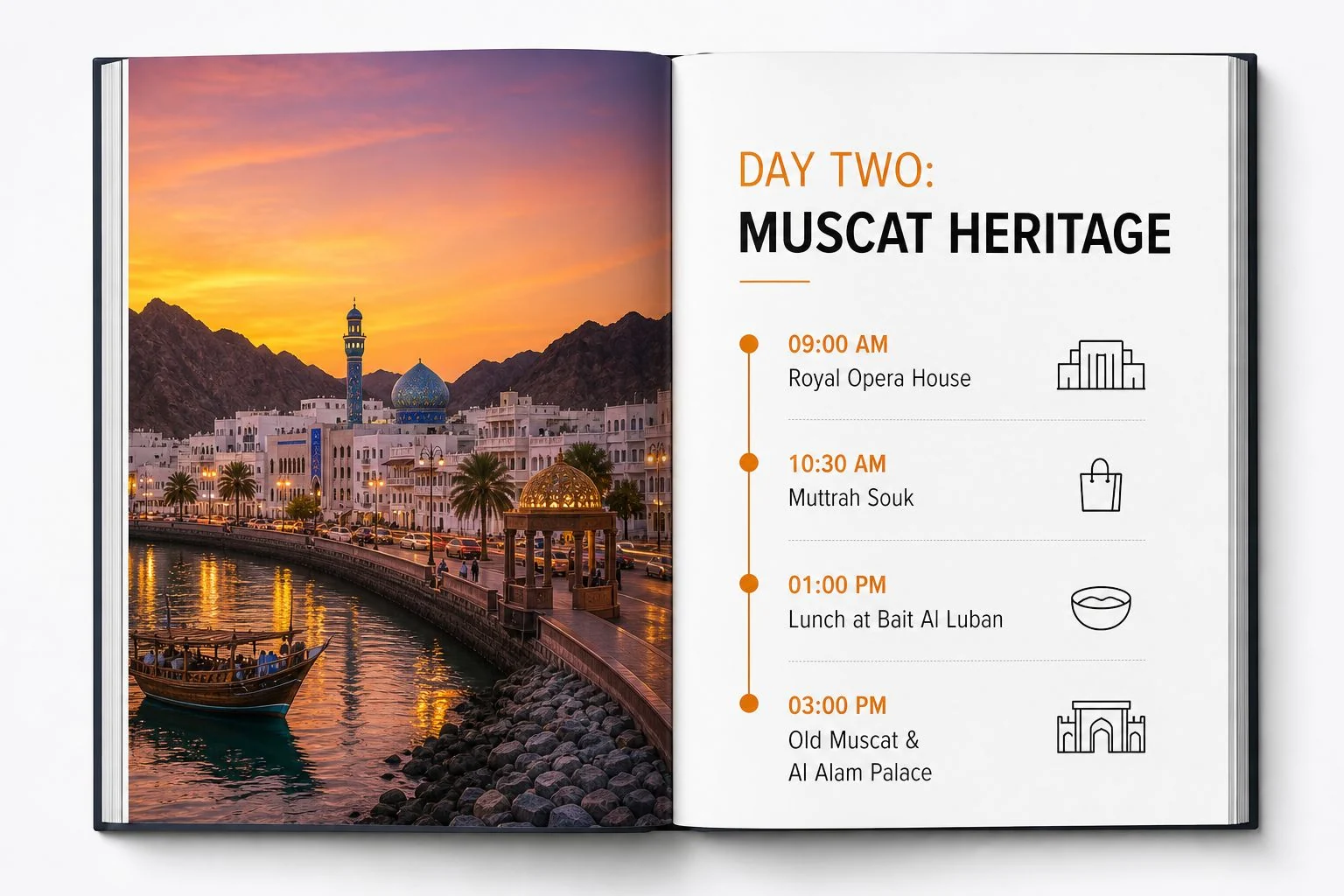
DAY 02
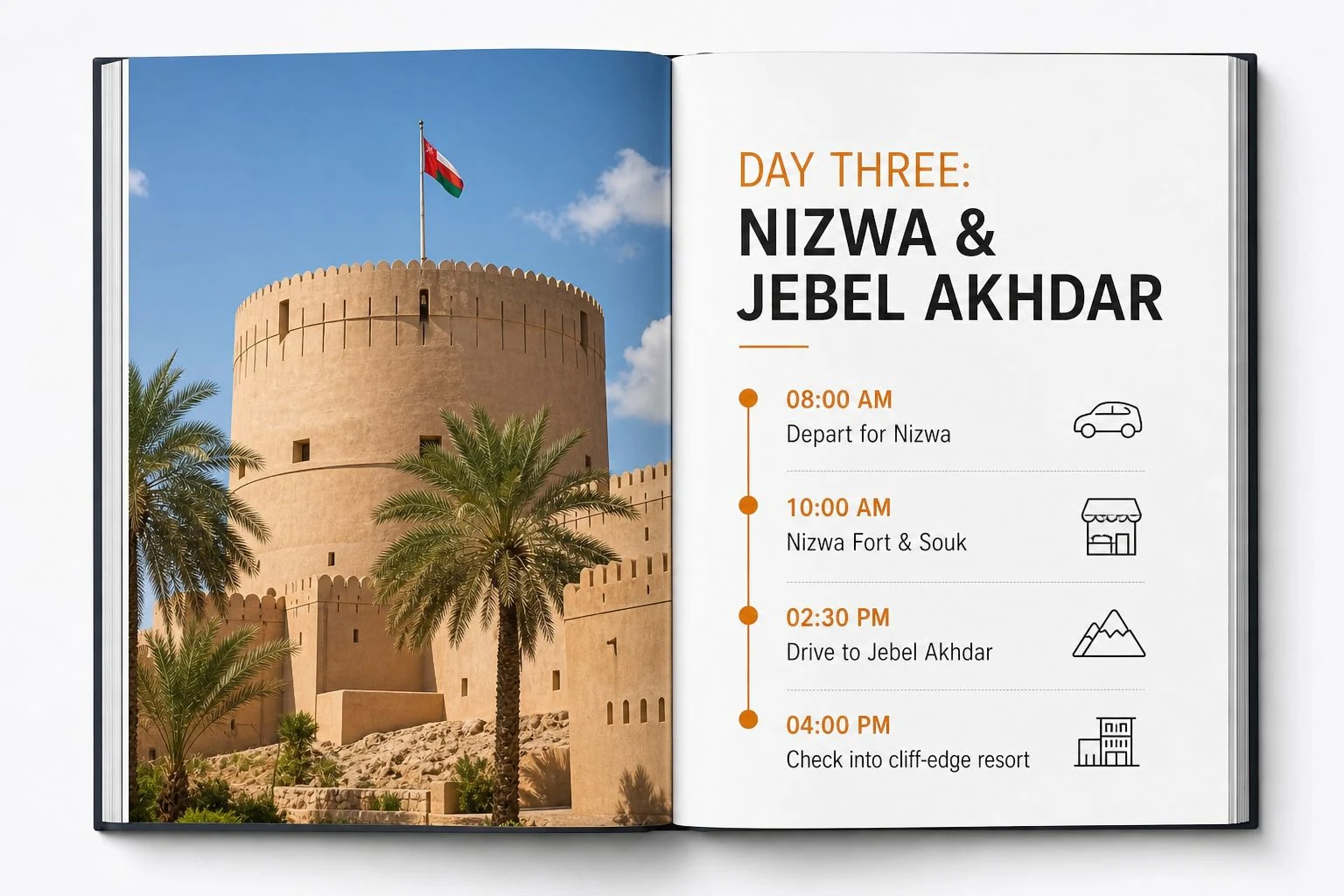
DAY 03
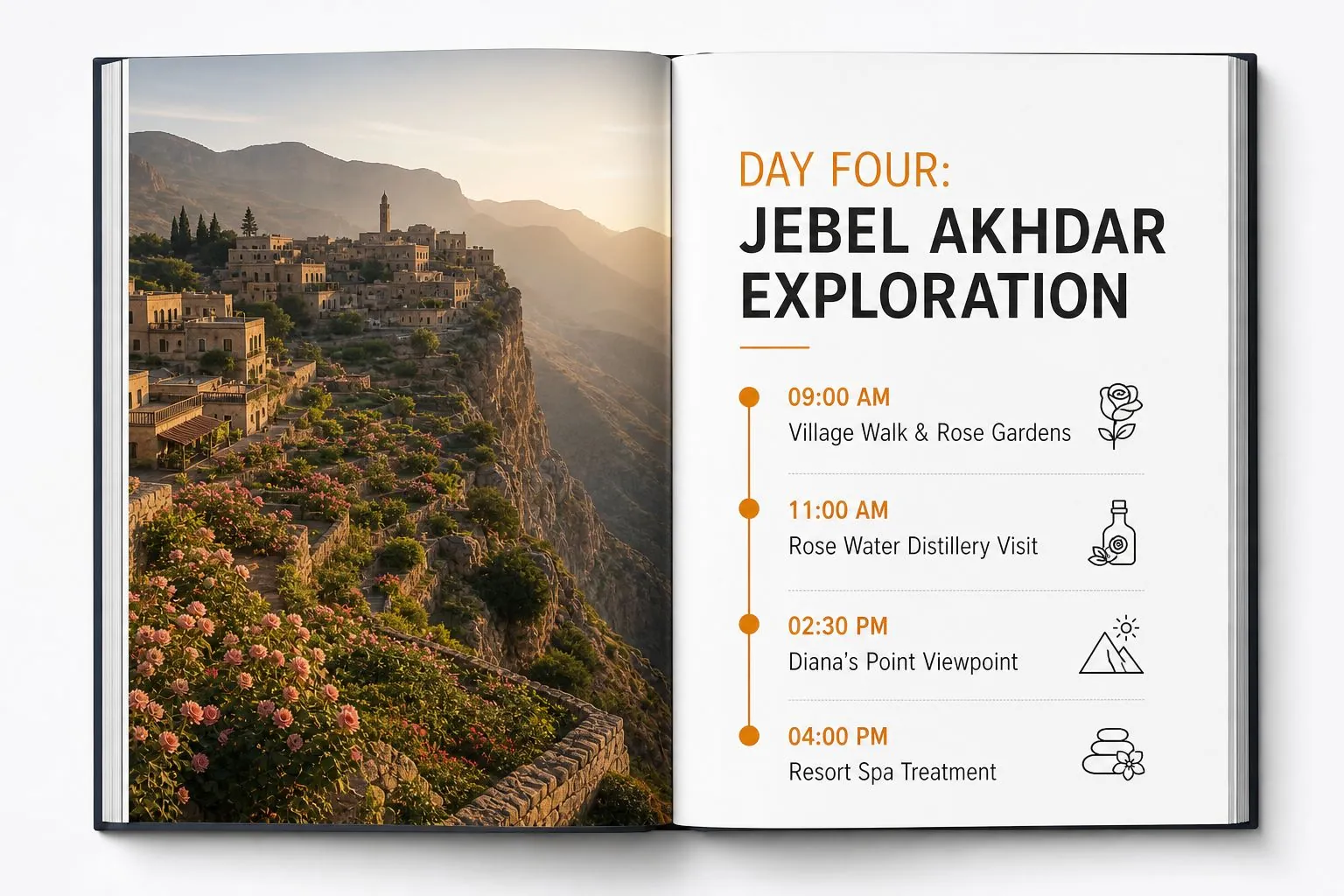
DAY 04
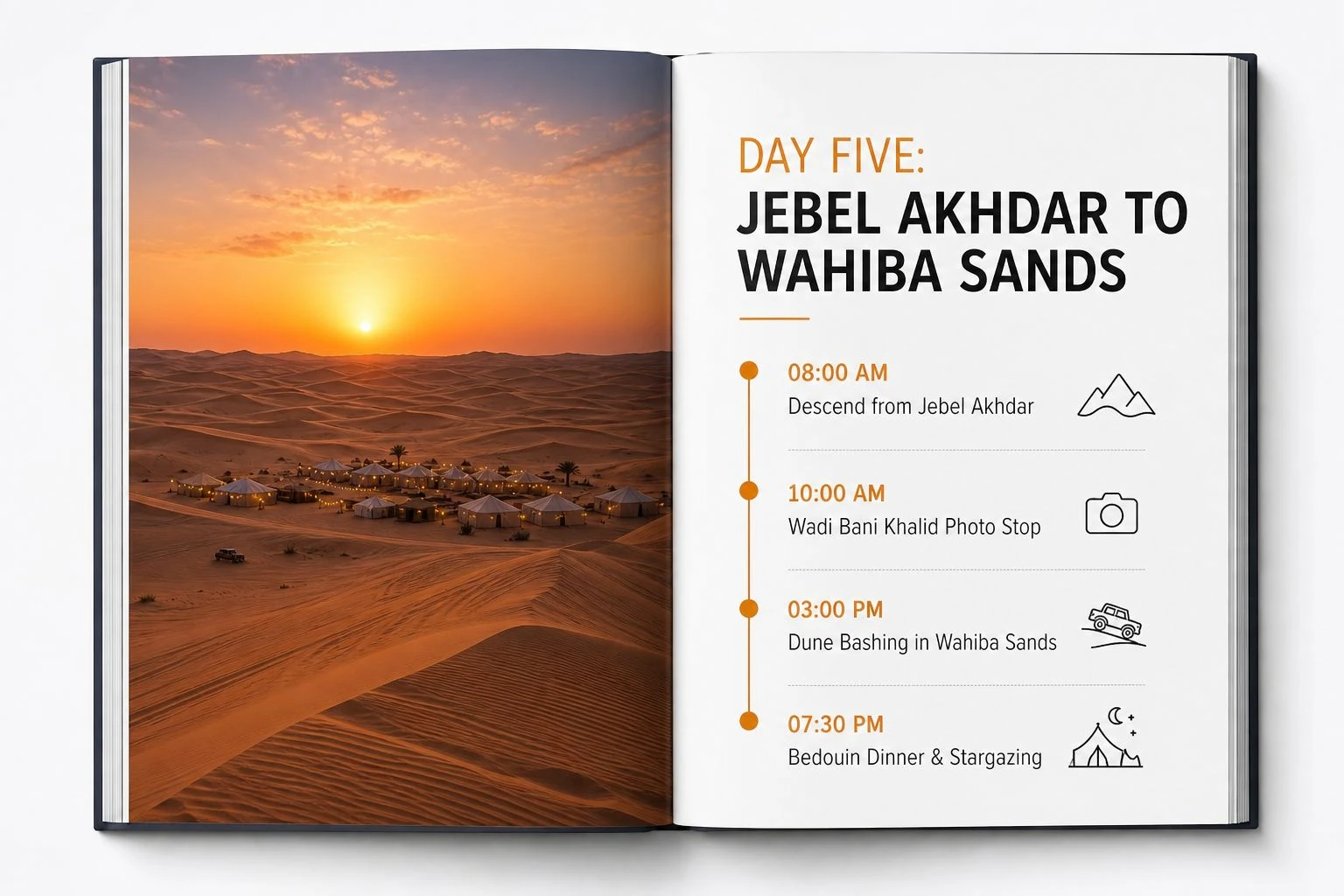
DAY 05
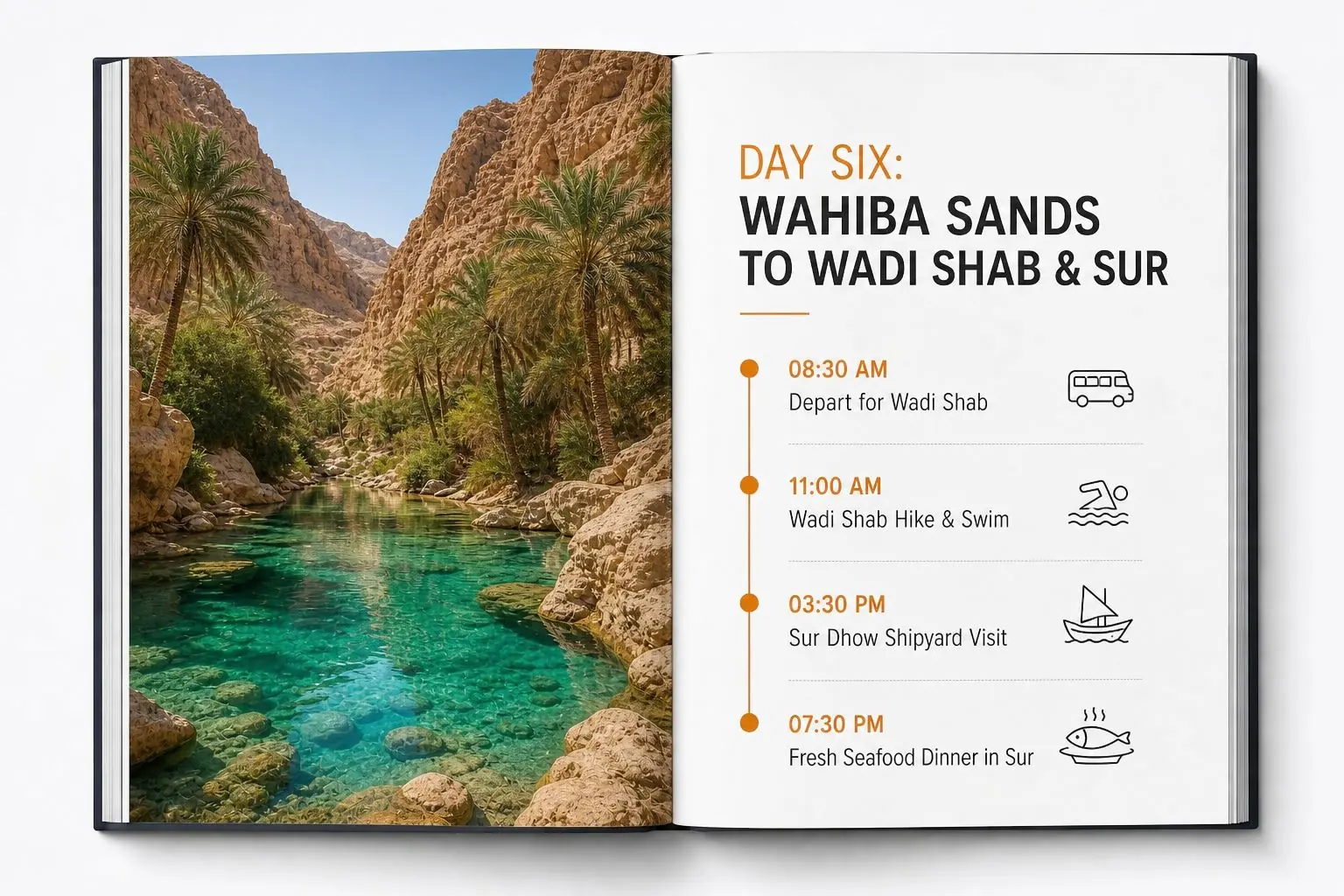
DAY 06
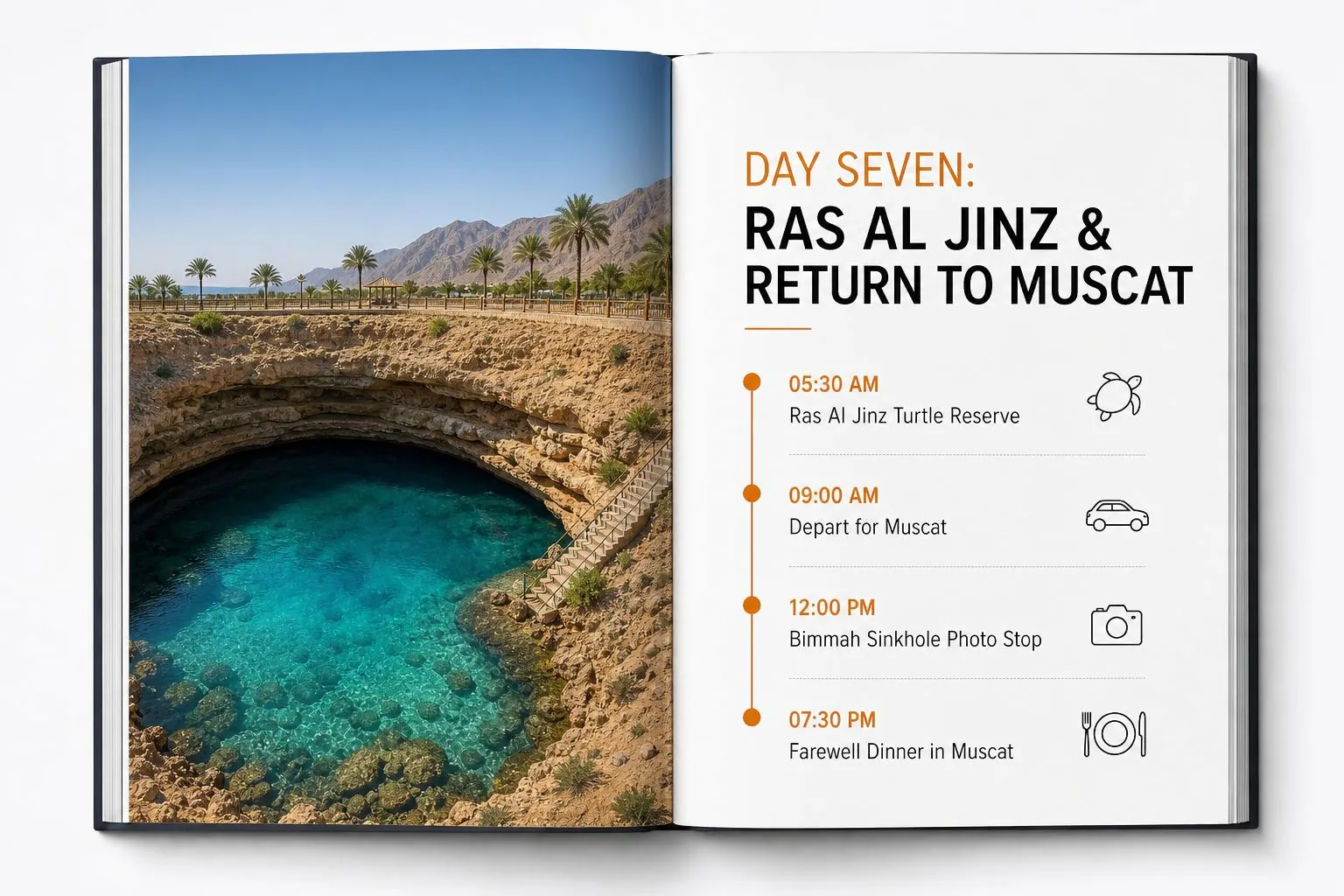
DAY 07
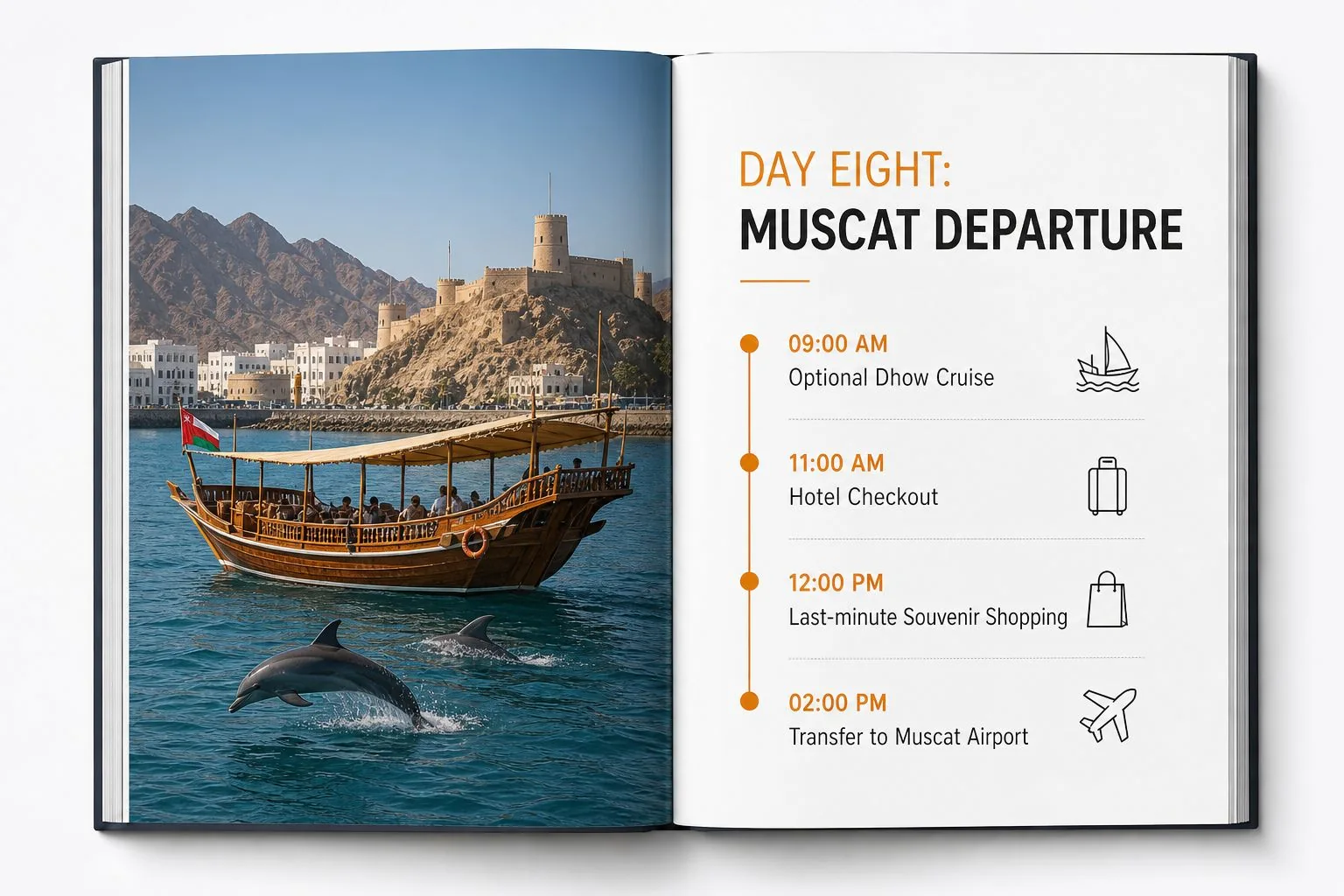
DAY 08
EXAMPLE DAY PLAN B
A shorter framework for a combined Arabia itinerary.
01
14:00 – Arrive Muscat. Hotel check-in. Grand Mosque visit. Dinner at hotel.
02
08:00 – Royal Opera House, Muttrah Souk, Old Muscat. Lunch at Bait Al Luban. Evening at leisure.
03
07:00 – Depart for Nizwa. Fort, souk, lunch. Afternoon drive to Jebel Akhdar. Resort check-in. Dinner.
04
08:00 – Village walk and Diana's Point. Lunch. Afternoon drive to Wahiba Sands. Dune bashing, sunset, camp dinner.
05
06:00 – Sunrise in Wahiba. Breakfast. 09:00 – Drive to Muscat (3 hours). 13:00 – Airport. Departure.
WHERE TO STAY
01
Shatti Al Qurum (the Corniche) offers sea-view luxury: The Chedi, Grand Hyatt, Park Hyatt. Ideal for beach access and resort amenities. Old Muscat (near the palace and forts) has smaller boutique options with historic atmosphere but limited dining. Al Khuwair is the business district: modern, convenient, less character.
02
Alila Jebel Akhdar and Anantara are the two luxury options, both perched on cliff edges with infinity pools overlooking canyon depths. Rooms start at $400/night but include breakfast, spa credits, and guided walks. Mid-range options exist in nearby villages but lack resort amenities. This is the most memorable accommodation in Oman.
03
Luxury camps (Desert Nights Camp, 1000 Nights Camp) offer private tents with ensuite bathrooms, solar power, and gourmet dining under the stars. Mid-range camps have shared facilities but excellent locations. Budget camping is possible with permits but not recommended for first-time visitors. All camps include meals and activities.
04
Sur Plaza Hotel and similar properties offer clean, comfortable rooms on the beachfront. Do not expect luxury: the value is location, fresh seafood, and access to the dhow shipyard. One night is sufficient.
First-timers: Muscat Corniche for convenience and beach access.
Honeymooners/romance: Alila Jebel Akhdar. The cliff-edge infinity pool is iconic.
Families: Muscat beach resorts with kids' clubs and pools.
Adventure seekers: Wahiba Sands luxury camp for desert immersion.
Cultural travelers: Nizwa guesthouses near the fort for authentic village life.
WHAT TO PACK + PRACTICAL TIPS
01
Modest clothing for religious sites and traditional villages: shoulders and knees covered. Lightweight long pants and shawls essential for mosque visits.
Swimwear and water shoes: Wadi Shab requires swimming through pools. Water shoes protect feet from sharp rocks.
Warm layers: Jebel Akhdar nights drop to 50°F even in summer. Desert nights in Wahiba are cold year-round (45-55°F).
Hiking shoes with grip: Wadi Shab, Jebel Akhdar village walks, and Wahiba dune climbing require proper footwear.
Sun hat with brim and UV-blocking sunglasses: Mountain and desert sun at 6,500 feet elevation is intense.
02
Sunscreen SPF 50+: High altitude and reflective sand intensify UV.
Rehydration salts: Essential for desert and mountain days.
Universal power adapter: Type C/G plugs. Voltage 220-240V.
Power bank: Long days without vehicle access to charging.
Waterproof phone case: Wadi Shab swimming requires protecting electronics from splashes.
Headlamp: For Wahiba camp navigation and Ras Al Jinz turtle walks.
Personal first-aid kit: Including blister plasters and anti-diarrheal medication.
03
Bring a red-light torch for Ras Al Jinz: white light disturbs nesting turtles. Red light allows observation without disruption.
Wadi Shab timing: Arrive at 8:00 AM for fewer crowds and better light. The pools are magical in morning sun.
Learn Omani Arabic greetings: Marhaba, shukran, afwan. Effort is appreciated.
Accept invitations: If a Jebel Akhdar villager offers tea, accept. Refusing is awkward.
Cash for souks: Credit cards accepted at hotels but cash useful for Nizwa market and village purchases.
No alcohol in public: Oman is more relaxed than Saudi Arabia but alcohol is restricted to licensed hotel bars. Do not bring your own.
EXTEND YOUR TRIP
01
Add 2-3 days for fjord-like coastline, dhow cruises through Khawr Najd, and mountain villages accessible only by boat. Called the 'Norway of Arabia.'
02
Add 3-4 days for the Khareef monsoon season (June-September). Green mountains, frankincense groves, and flowing waterfalls in the middle of Arabian summer.
03
Add 2 days for a guided expedition to the Rub' al Khali. Luxury desert camp on the Omani-Saudi-Yemeni border. The most remote accommodation in Arabia.
04
The natural pairing. Combine Oman's mountains and coast with Jordan's Petra and Dead Sea for the ultimate natural diversity. Jordan Journey's Arabia's Natural Wonders (JJ-MULTI-048) handles the Aqaba-Muscat flight connection.
05
After Oman's authenticity, experience Dubai's spectacle. The contrast is dramatic. Jordan Journey's Deserts to Skyscrapers (JJ-MULTI-047) coordinates the flight.
06
After Oman's natural landscapes, explore Saudi Arabia's archaeological depth. Hegra, Diriyah, and Al-Balad complete the Arabian picture.
FAQ
01
Most nationalities (US, UK, Canada, EU, Australia) can obtain a 10-day or 30-day e-visa online for approximately 25 USD. Processing takes 2-5 business days. Jordan Journey handles the entire application.
02
Oman is one of the safest countries in the world. Crime is virtually nonexistent. The Omani people are famously hospitable. Standard travel precautions apply, but the country is exceptionally welcoming and secure for all nationalities.
03
More affordable than Dubai but pricier than Egypt. Luxury resorts (Alila Jebel Akhdar, The Chedi Muscat) cost $300-600/night. Mid-range hotels cost $80-150. Meals range from $5 at village cafes to $80 at resort restaurants. Jordan Journey packages include accommodations and most meals, making costs predictable.
04
Omani Rial (OMR) is the official currency. 1 OMR = approximately 2.60 USD. USD is accepted at some tourist sites but change is given in Rials. Credit cards widely accepted at hotels and resorts. We recommend carrying 200-300 USD equivalent in Rials for tips, souk purchases, and small expenses. ATMs available in Muscat, Nizwa, and Sur. Your guide assists with exchange.
05
Excellent. Wadi Shab is thrilling for children (with supervision). Desert camps fascinate all ages. Muscat's beaches and resorts are family-friendly. The pace is slower than Dubai, making it ideal for multi-generational travel. Jordan Journey guides adapt activities for families.
06
Yes. Omani law requires 4×4 vehicles for the mountain road due to steep gradients and switchbacks. Jordan Journey arranges both the vehicle and the mountain driving permit. Our professional drivers handle all mountain and desert terrain. You never need to drive yourself.
07
Non-swimmers can enjoy the first shallow pools (3-4 feet deep) and walk to the cave viewpoint without entering deep water. Life jackets are provided for all guests who wish to swim. The deepest pool reaches 15 feet. Our guide accompanies the group and carries flotation devices. Children under 12 should be accompanied by an adult.
08
Frankincense from Muttrah Souk (buy the highest grade, Hojari), silver khanjar daggers (miniature replicas available), Omani halwa from Sur, date honey from Nizwa, and rose water from Jebel Akhdar (March-April harvest). Avoid fake antiquities.
09
Yes. Some restaurants close during daylight hours in smaller towns, but hotels and resorts serve food normally. Sites may have reduced hours. Evening iftar meals are culturally rich. Our guides adjust itineraries. Book 60+ days ahead during Ramadan.
10
Green turtles nest from May to October, with peak activity June-August. Outside these months, sightings are less likely but possible. The reserve operates guided tours only. We book your entry in advance. If turtles are not sighted due to natural patterns, we offer alternative coastal activities. No refunds for missed sightings: this is wildlife, not a scheduled performance.
11
In tourist areas, hotels, and restaurants: yes. In traditional villages and souks: limited but sufficient for basic transactions. All Jordan Journey guides speak fluent English. The Omani education system emphasizes English, and younger generations are typically bilingual.
12
Heat exhaustion and dehydration are the primary risks. Drink 3-4 liters of water daily. No mandatory vaccinations. Tap water is treated but bottled water recommended. Medical facilities in Muscat are excellent. Jebel Akhdar's altitude (6,500 feet) is moderate and causes no issues for most travelers. Travel insurance with medical evacuation is mandatory.
YOUR JOURNEY, SHAPED AROUND YOU
Our team will shape the sequence, pacing, stays, access, and transfers around your dates and interests.