
DESTINATIONS / JORDAN
A modern capital built on ancient hills, where Roman ruins meet contemporary culture and culinary discovery.
60-SECOND SNAPSHOT
Jordan’s capital is both the natural gateway to the country and a destination in its own right—layered, social, food-led, and strategically placed for northern exploration.
BEST FOR
IDEAL STAY
ROUTING ROLE
A city of four million people, featuring ancient Roman ruins, bustling souks, contemporary art galleries, and a renowned food scene. The capital serves as Jordan’s political, cultural, and economic center.
Who it is best for: Culture seekers, food enthusiasts, and travelers using Amman as a base for northern Jordan. The city rewards curiosity and appetite.
Ideal duration: One full day for highlights; two days with northern day trips; longer for deep cultural immersion.
WHY IT IS SPECIAL
Amman’s location makes it the logical hub for northern Jordan—Jerash, Ajloun, and the Umm Qais region are all accessible as day trips. The city provides urban comfort between rural explorations.
01
The Citadel contains ruins from the Bronze Age through the Islamic period, including the Temple of Hercules and Umayyad Palace.
02
A 6,000-seat amphitheater carved into downtown Amman’s hillside, still used for performances.
03
Amman is Jordan’s culinary capital—from street falafel to fine dining, the city offers the country’s best eating.
04
Each district has a distinct personality: downtown’s energy, Rainbow Street’s cafes, and Abdoun’s embassy quarter.
05
Galleries, street art, and cultural centers showcase Jordan’s creative scene.
06
Amman’s airport is Jordan’s main entry point. The city naturally starts or ends most itineraries.
TOP HIGHLIGHTS
Amman is best understood through contrast: hilltop archaeology, downtown street life, creative neighborhoods, and evenings built around food.
01
Ancient hilltop ruins spanning millennia, with the Temple of Hercules, Umayyad Palace, and panoramic city views.
02
A remarkably preserved 2nd-century amphitheater in downtown. Climb to the upper rows for photos and perspective.
03
The city’s most walkable thoroughfare—cafes, restaurants, shops, and evening strolling.
04
The historic core—souks, mosques, street food, and the energy of daily Jordanian life.
05
The country’s most important archaeological collection, including major Dead Sea Scrolls material.
06
A striking blue-domed mosque that welcomes non-Muslim visitors under current access rules.
07
Modern Amman through shopping, dining, public space, and contemporary architecture.
08
Murals and installations across the city, particularly in Jabal Al-Weibdeh.
IDEAL DURATION
The city can work as a focused arrival day, a two-day cultural base, or a slower introduction to northern Jordan.
01
City Highlights
Covers the Citadel, Roman Theatre, downtown souks, and Rainbow Street. Sufficient for a taste of Amman but rushed. Best for those prioritizing other destinations.
02
City Plus Day Trip
One day for Amman itself; a second day for Jerash or another northern site. This is the recommended approach for most visitors.
03
Deeper Exploration
Adds neighborhood wandering, food-focused exploration, and perhaps the Dead Sea or Mount Nebo as a second day trip.
BEST TIME + COMFORT
Amman rewards seasonal awareness and a simple time-of-day strategy: active mornings, protected middays, and social evenings.
01
March–May
Pleasant temperatures and wildflowers on the hillsides. Ideal for walking and outdoor dining.
02
June–August
Hot and dry. Prioritize early sightseeing, midday breaks, and social evenings.
03
September–November
Excellent conditions, clear skies, and comfortable temperatures for all activities.
04
December–February
Cool with occasional rain and the fewest visitors. Museums and the food scene come into their own.
TIME OF DAY
Best for the Citadel and Roman Theatre—cooler temperatures and better light for photography.
TIME OF DAY
Use museums, cafe breaks, or hotel rest to manage summer heat and traffic.
TIME OF DAY
Rainbow Street comes alive. Dinner is the social event of the day.
Planning note: Operating details, access conditions, and ticket rules can change. Jordan Journey confirms the latest information for your exact travel dates.
GETTING THERE + ROUTING LOGIC
Queen Alia International Airport is Jordan’s main entry point, south of the city. Most visitors arrive by air, use Amman for orientation and northern exploration, then move south.
01
Most itineraries begin in Amman. Allow a day to recover from travel before northern day trips.
02
The city works well for departure preparation, with a final night positioned for airport access.
03
Jerash, Ajloun, and Umm Qais are day-trip accessible. Position Amman between these explorations.
01
Recover, orient, and explore the capital.
02
Jerash, Ajloun, and Umm Qais as day trips.
03
Continue toward Petra via the Desert or King’s Highway.
04
Use Wadi Rum after Petra for a slower, contemplative change of pace.
05
End in Aqaba, or return to Amman for departure.
Start in Amman for arrival recovery and northern exploration. Move south to Petra, Wadi Rum, and Aqaba. Return to Amman for departure, or depart from Aqaba’s airport when flight schedules make that practical.
EXAMPLE DAY PLAN A
A balanced Amman stay with one full urban day and one Jerash-focused day. Timings are examples and are adjusted for season, traffic, and your pace.
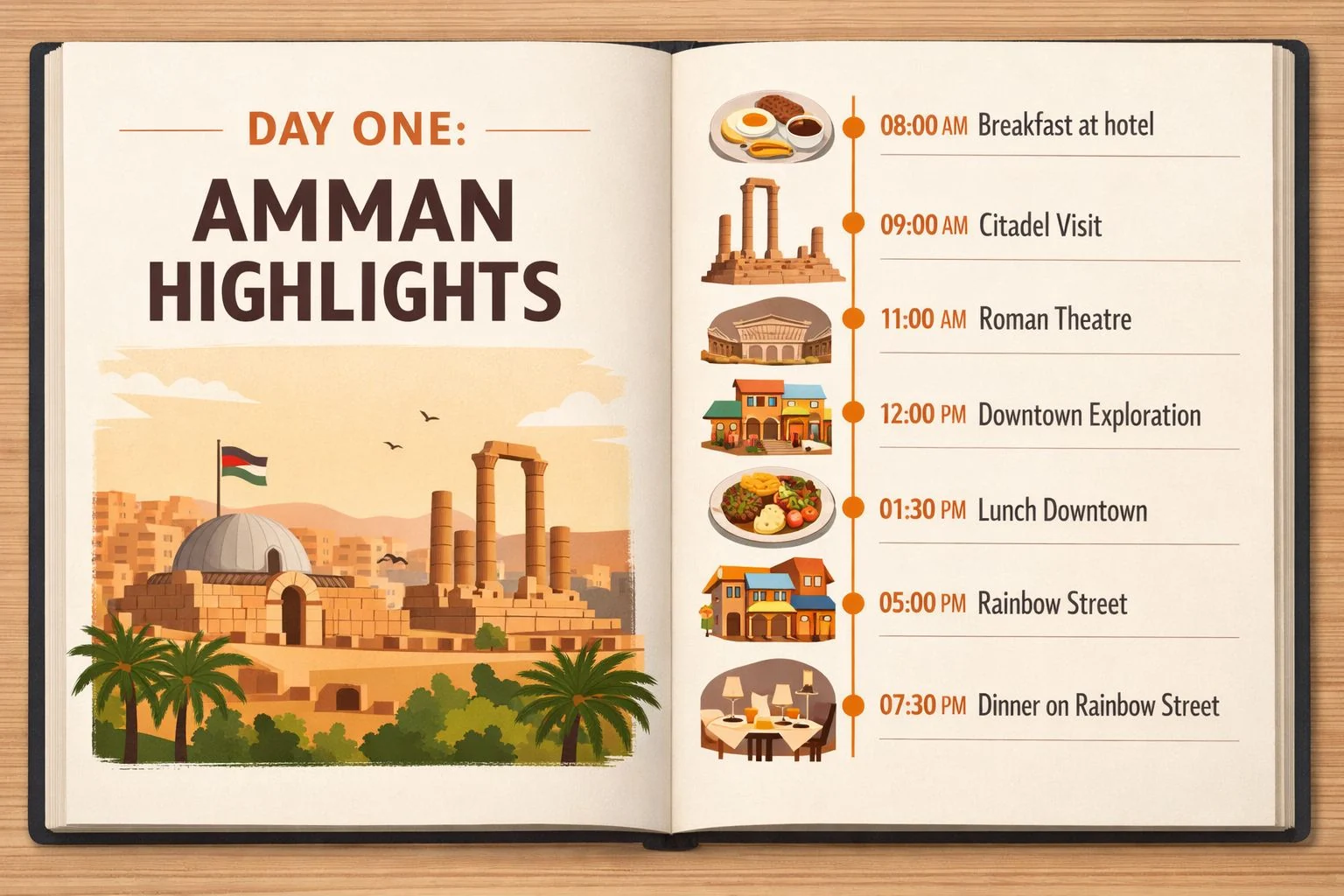
08:00
Breakfast at the hotel or a local cafe.
09:00
Citadel visit: Temple of Hercules, Umayyad Palace, and the site museum.
11:00
Walk downhill to the Roman Theatre.
12:00
Explore downtown souks and street life.
13:30
Lunch downtown—falafel or mansaf.
15:00
Rest at the hotel or visit the Jordan Museum.
17:00
Rainbow Street: coffee, walking, and people-watching.
19:30
Dinner on Rainbow Street or in Abdoun.
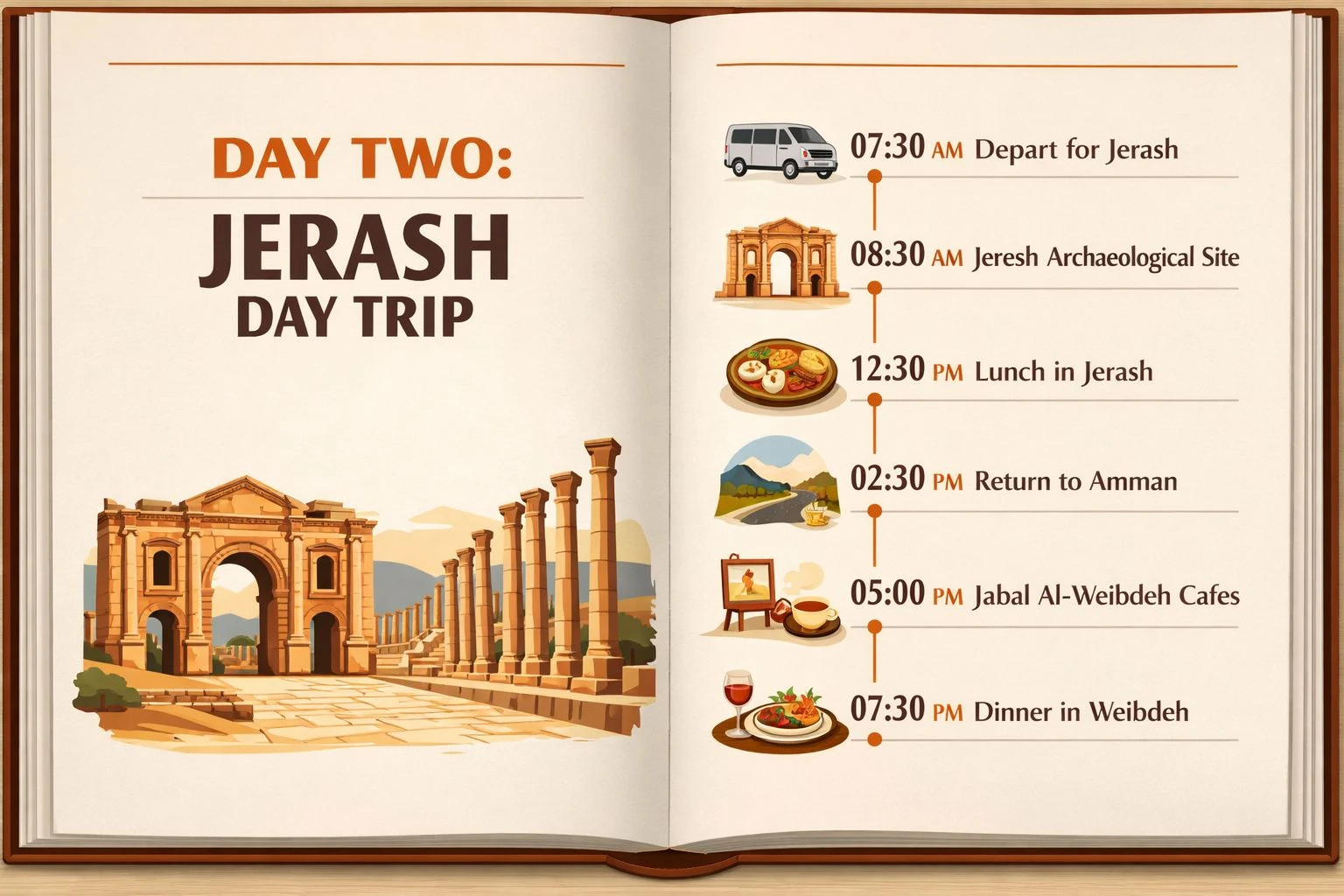
07:30
Depart for Jerash.
08:30
Explore Jerash: Hadrian’s Arch, the Forum, and the colonnaded streets.
12:30
Lunch in Jerash or begin the return to Amman.
14:30
Return to Amman; rest or explore Jabal Al-Weibdeh.
17:00
Cafe time in Weibdeh—art galleries and coffee culture.
19:30
Dinner in a different neighborhood.
EXAMPLE DAY PLAN B
A compact version that preserves Amman’s essential archaeology, downtown energy, and evening atmosphere without turning the day into a race.
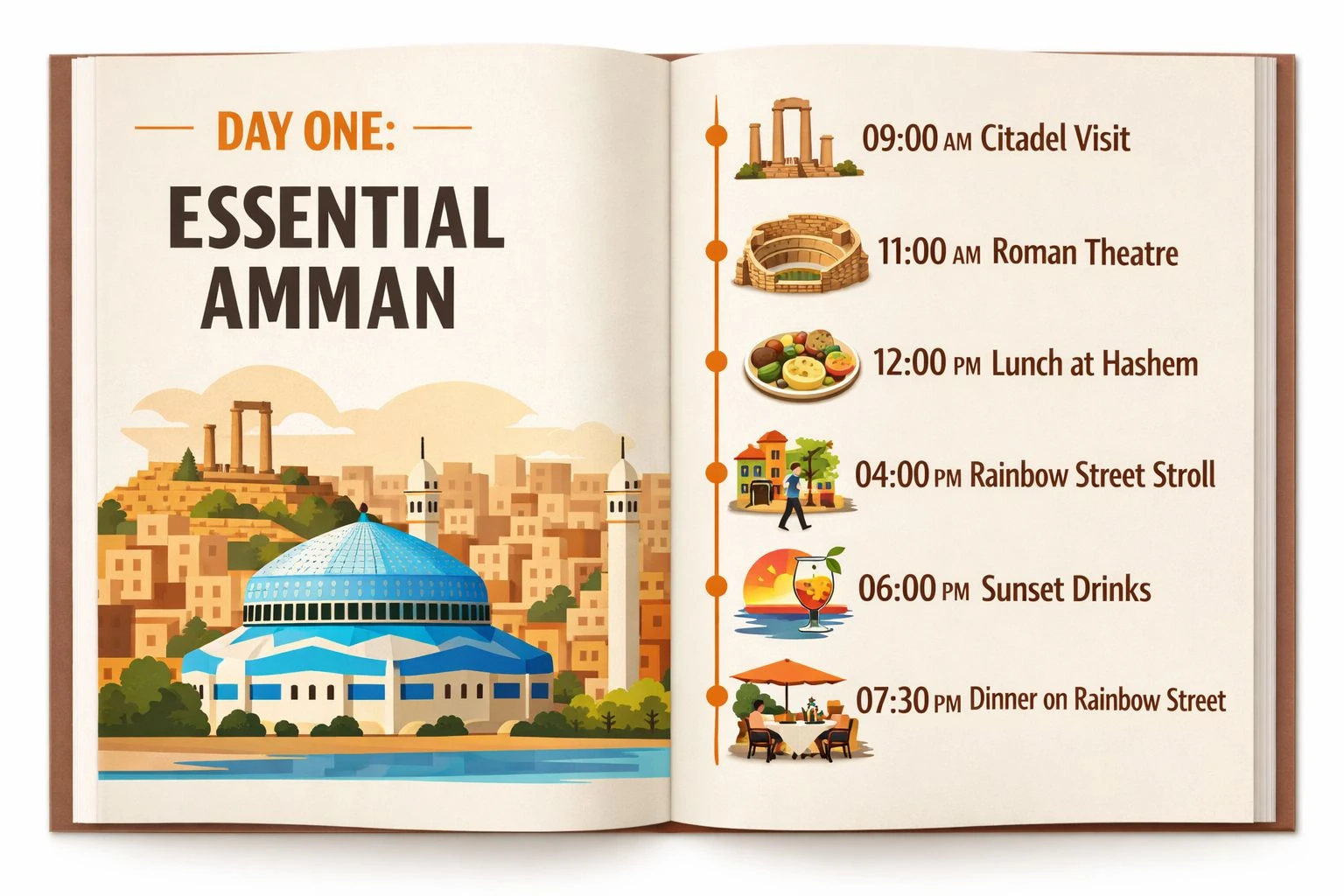
09:00
Citadel visit.
11:00
Roman Theatre.
12:00
Downtown lunch—Hashem for falafel.
14:00
Rest or hotel break.
16:00
Rainbow Street stroll.
18:00
Sunset drink with city views.
19:30
Dinner on Rainbow Street.
WHERE TO STAY
Location changes the feel of an Amman stay more than it changes access to the main sights.
01
The upscale embassy district with international hotels, shopping, and dining. Quieter than downtown and strong for travelers prioritizing comfort.
02
A practical business district with mid-range and luxury hotels, a central position, and good restaurant options.
03
Boutique hotels and character properties within walking distance of cafes and restaurants. Best for neighborhood immersion.
04
Budget options and traditional atmosphere near the Roman Theatre and souks. Basic but authentic.
First-time visitors often prefer Abdoun or Shmeisani for comfort and convenience. Return visitors and culture seekers may prefer the character and walkability of Jabal Amman.
WHAT TO PACK + PRACTICAL TIPS
Amman is welcoming and manageable, but hills, heat, traffic, and neighborhood geography reward a little preparation.
01
02
03
04
EXTEND YOUR TRIP
Use the capital as a base for northern archaeology, sacred landscapes, or a transition into the rest of Jordan.
The best-preserved Roman city in the Middle East. Essential as a half-day or full-day extension from Amman.
A 12th-century castle and forested hills. Combine with Jerash for a complete northern day.
Ancient Gadara with far-reaching northern views. Best as a full-day trip or part of a slower northern route.
A natural pairing of mosaic heritage, sacred history, and Jordan Valley views.
FAQ
These answers provide planning guidance. Exact access conditions and operating details are confirmed for your travel dates.
01
One full day covers the highlights. Two days allow for a northern day trip. Three days support deeper exploration and multiple extensions.
02
Amman is widely regarded as a safe and welcoming capital. Use normal urban precautions and follow current local guidance.
03
Abdoun and Shmeisani offer international comfort. Jabal Amman offers character and walkability. Downtown is budget-friendly and authentic.
04
Falafel, hummus, mansaf, knafeh, and fresh juice are essential. Rainbow Street and Jabal Al-Weibdeh add strong cafe and restaurant options.
05
Yes. Jerash works as a half-day site visit or a full-day outing with lunch and slower exploration. It can also be paired with Ajloun.
06
Modest dress is appreciated, especially around religious sites and traditional neighborhoods. Hotels and Rainbow Street are more relaxed.
07
Costs are moderate and vary widely by neighborhood and hotel tier. Street food is affordable; luxury accommodation and dining are readily available.
08
Spring and autumn offer the most comfortable walking weather. Summer is hot and winter is cool with occasional rain.
09
No. Taxis and ride-hailing are plentiful. A private driver or rental car is more useful for regional day trips than for central city sightseeing.
10
Rainbow Street is the best-known evening hub, while Abdoun and Weibdeh offer dining, cafes, lounges, and neighborhood atmosphere.
11
Partly. Downtown, Rainbow Street, and individual neighborhoods are walkable, but the hills make distances deceptive. Use taxis to connect areas.
12
Arabic is the official language. English is widely spoken in hotels, restaurants, and visitor-facing businesses.
13
Alcohol is available in licensed hotels, bars, and some restaurants. Availability is limited outside visitor-oriented areas; local customs should be respected.
14
The Jordanian Dinar (JOD). ATMs are widely available, cards are accepted in larger businesses, and cash remains useful in souks and small restaurants.
JORDAN JOURNEY
A Jordan Journey specialist can shape the arrival rhythm, northern day trips, hotel area, and onward route around your dates, pace, and priorities.